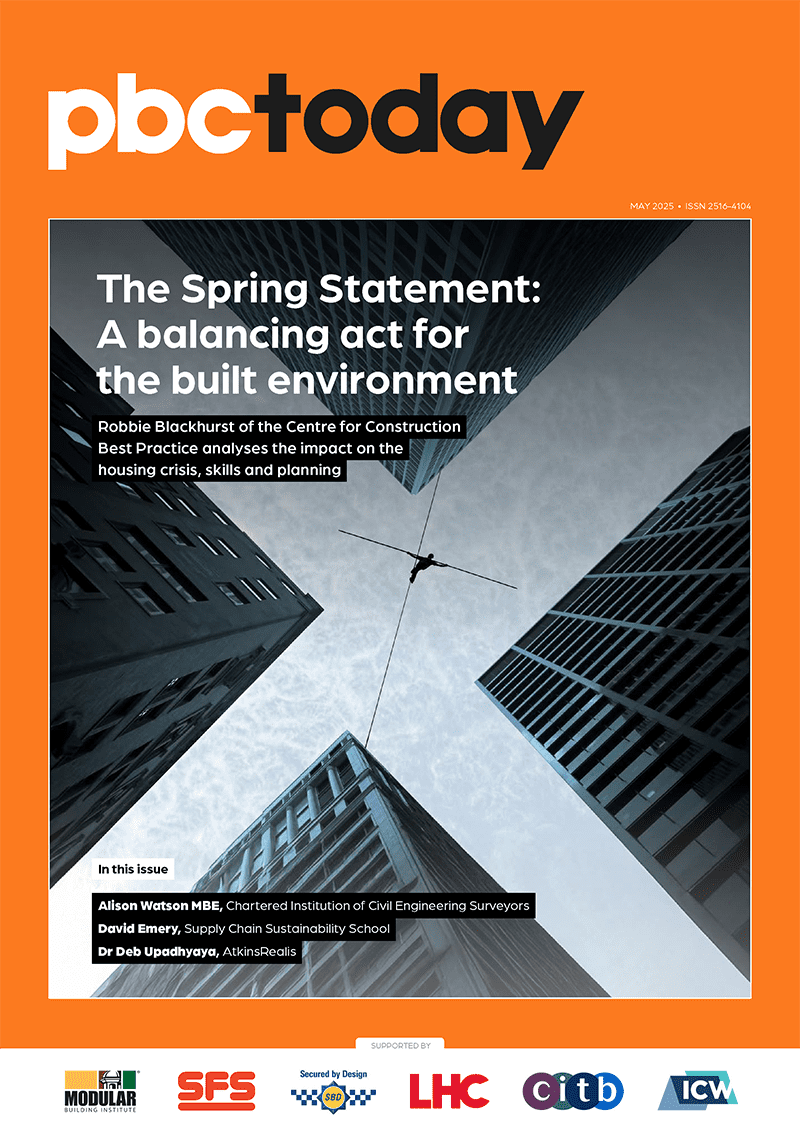

Welcome to the May 2025 edition of PBC Today. In another bumper edition, our expert contributors analyse everything from the impact of the Spring Statement and US tariffs on the construction industry to the urgent case for reforming payments, tackling cladding remediation and the role of technology in delivering the monumental restoration of the Houses of Parliament
In our PBC Today May 2025 cover story, Robbie Blackhurst, chair of the Centre for Construction Best Practice, looks behind the headlines of the Spring Statement, warning that while the extra £2bn in capital funding for housing is a significant step, much more is needed to address the UK’s housing crisis and skills shortages.
Matt Smart of Barkers Commercial Consultancy examines the implications of President Trump’s tariffs for UK construction and how the sector can build its resilience in an uncertain world.
Meanwhile, Alison Watson MBE, president of the Chartered Institution of Civil Engineering Surveyors, discusses the launch of the CICES Education Panel, which brings together industry and academics to create a clearer path into the industry.
In BIM & Digital, Dr Deb Upadhyaya and Andrew Alsbury of AtkinsRéalisn size up the task of delivering the government’s New Towns, arguing that we need to rethink not only what we build, but how we build it.
Elsewhere, Jackie Maginnis of the Modular & Portable Building Association makes the case for offsite in ensuring the government’s School Rebuilding Programme is fit for purpose, David Emery of the Supply Chain Sustainability School looks at de-risking offsite projects and Andrew Cowan of OneClickLCA examines the importance of lifecycle assessment in Modern Methods of Construction.
Here’s a selection of what’s in store in PBC Today May 2025:
1. £2bn housing boost: A step forward, but more is needed to solve the crisis
Robbie Blackhurst, chair of the Centre for Construction Best Practice, analyses the Spring Statement and its likely impact on the housing crisis, skills and planning.
2. Global costs, local consequences: How UK construction procurement must adapt to increasing tariffs
What do President Trump’s tariffs mean for the UK construction industry and how can the sector build its resilience in an uncertain world? Matt Smart, delivery director for Barkers Commercial Consultancy, takes a look.
3. CICES Education Panel: Setting the bar and taking responsibility for education
Alison Watson MBE, president of the Chartered Institution of Civil Engineering Surveyors, discusses the launch of the CICES Education Panel, which is bringing together business and academics to create a clearer, more coherent path into the industry.
4. Beyond the backlog: Why the UK’s cladding remediation is a systems failure
Eight years on from the Grenfell Tower tragedy, the UK’s cladding remediation programme continues to falter. Despite increased scrutiny and substantial public funding, progress remains unacceptably slow and is a national crisis that is deepening, writes Sián Hemming-Metcalfe, operations director at Property Inspect.
5. The “jobs tax” no one voted for: How NIC increases threaten the construction industry
The increase in employers’ National Insurance Contributions is an unfair burden on the SMEs that make up the vast majority of the construction industry, threatening hiring and growth, argues Catherine Storer of Essential Site Skills.
6. The grey belt: A golden opportunity?
The government’s plan to make it easier to build on green belt is likely to have limited impact on housebuilding in the short term, writes Joe Ridgeon of Hedley Planning.
7. New Towns, new communities, new approach: The case for integrated delivery
New Towns present a huge opportunity but to avoid the mistakes of the past, we must rethink not only what we build but how we build it, write Dr Deb Upadhyaya and Andrew Alsbury of AtkinsRéalis.
8. Restoration of Parliament and the floating solution
Restoring the Houses of Parliament is a monumental task fraught with physical, planning and even political challenges. Petr Mitev of Chaos examines the complexity of restoring such a historical site, the role of technology and the reality of building a floating temporary home for the “mother of parliaments” on the Thames.
9. Will doubling the School Rebuilding Programme target have the desired outcome?
Is the UK’s School Rebuilding Programme fit for purpose? Jackie Maginnis, chief executive of the Modular & Portable Building Association, scrutinises the detail and considers if the Labour government will do any better than the previous regime.
10. Beyond compliance: Why the Future Homes Standard should be a starting point, not the finish line
Dr Anthony Greer, corporate strategy director of offsite housing specialist TALO, looks at why the Future Homes Standard represents a welcome move in the right direction for improving the energy performance and sustainability of new homes. He also considers why it feels more like catching up than moving ahead.