

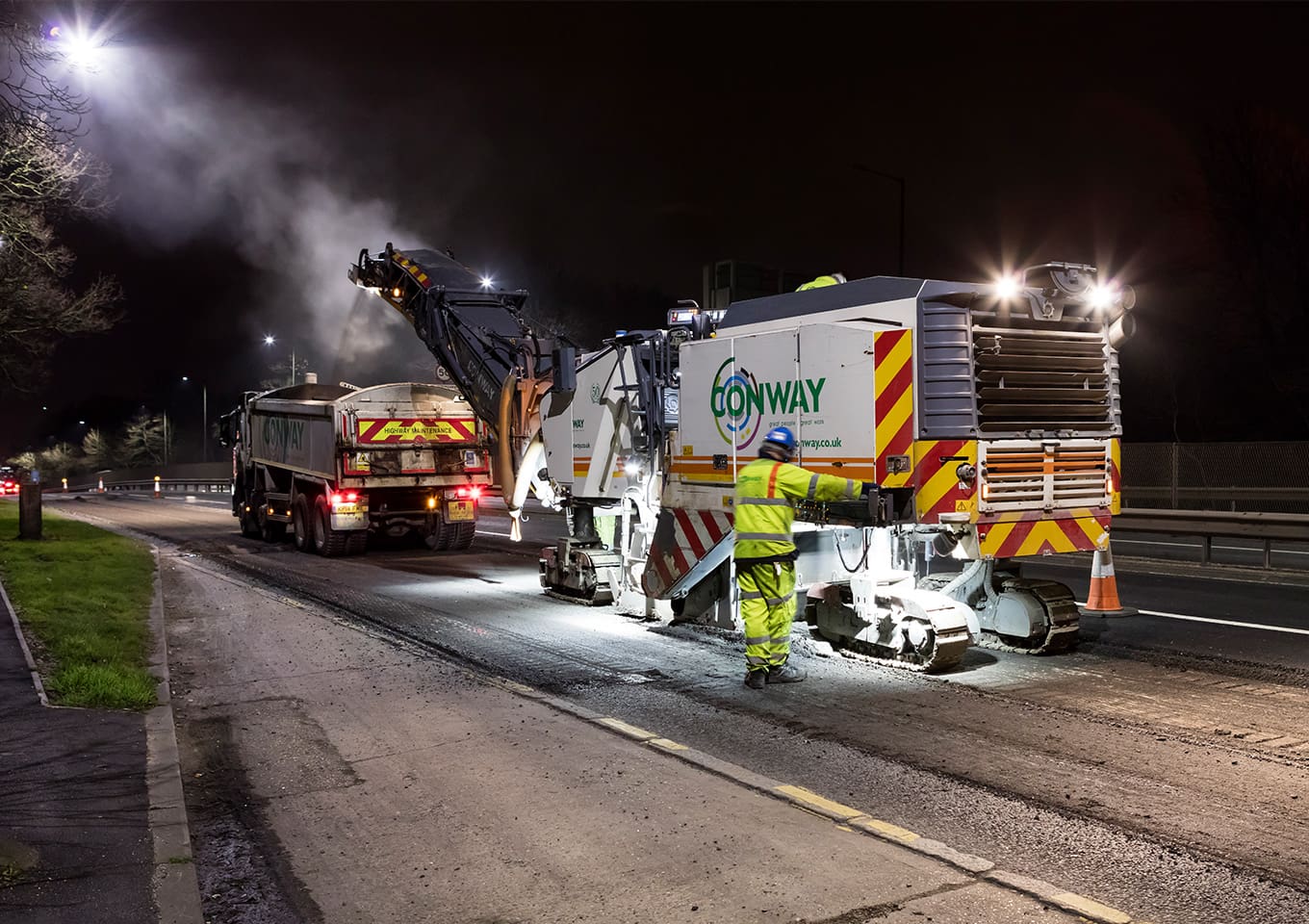
Transport for London(TfL) contractor FM Conway trialled a mix of 50% recycled asphalt planings (RAP) on a pavement section of the A1 in 2016 and found that it matched or even outperformed traditional asphalt materials on durability and longevity
Two lanes of the A1 Mill Hill road were laid in 2016 with a 50% RAP mix and a third lane was set with a standard mix as a control. Both mixes contained polymer modified bitumen (PMB) and the RAP mix was sourced from the high speed network.
The most recent testing of the mixes took 18 samples and tested a variety of factors and found that:
- Both mixes tested well for water sensitivity, water resistance and bonding with lower layers
- The 50% RAP mix had better rutting resistance(1.2mm ruts after wheel track testing versus 1.6mm for the regular mix)
- The 50% RAP mix also performed better in stiffness(3,033MPa as compared to the standard material’s 4,488MPa)
Significantly boosting sustainability in Britain’s roads
The most recent figures from the European Asphalt Pavement Association (EAPA) found in 2023 that Great Britain produced around 22.6m tonnes of asphalt, the second year in consecutive decline since the decade’s peak of 25.7m tonnes in 2021. Of the 5.4m tonnes of site-won asphalt produced in 2023, 38%(roughly 2.05m tonnes) was reintegrated into road layers.
Utilising recycled asphalt would help establish a greater circular economy in UK infrastructure. Great durability and longevity would reduce the need for maintenance or replacement works, which would reduce the emissions associated with these works.
However, high proportions of RAP do require a more intensive manufacturing process, where heat and water content conditions may require specialist asphalt plant technology.
Parallel drum plant is required for mixes above 40%, of which there are only seven units in the UK.
Increased RAP testing is becoming more common
Currently, National Highways only permits 10% of recycled materials in road surfaces- although updates to the Manual of Contract Documents for Highways Works (MCHW) due later this year will increase this threshold to 20%. National Highways has also carried out 14 trials with higher RAP proportions over the last five years, as have FM Conway, who laid a 92% RAP stretch of road in Westminster in 2024.
Other highway authorities set their own thresholds, but the majority follow the MCHW. TfL has already added a clause permitting unlimited RAP usage if contractors can demonstrate that they are meeting standards of quality and performance.
“Still a long way to go” to making recycled asphalt standard practice
Isabel Coman, TfL’s director of engineering and asset strategy, said: “We are committed to reducing carbon emissions across our assets and infrastructure to help us meet our net zero targets. By trialling a higher proportion of recycled asphalt on the A1 at Mill Hill, we’ve become one of the first authorities in the UK to successfully incorporate 50% RAP in the top layer of one of our major roads and proved its ability to withstand heavy traffic loading.
“This trial demonstrates our commitment to sustainability and gives a strong signal to the supply chain that we are seeking innovative solutions to reduce the embedded carbon in our major construction materials. We hope this encourages other highway authorities to conduct similar trials and continue to drive improvements in the sustainability, reliability and durability across the sector.”
FM Conway technical director Mark Flint said: “The use of high levels of recycled asphalt has grown significantly but there’s still a long way to go to making it standard practice. The results of our work with TfL validate what we’ve known all along: that RAP can deliver comparable results to mixes made entirely with virgin materials.
“The trial has proven that sustainability and innovation advances can be made without compromising the quality and durability of our roads. Partnerships built on trust, like the one we have forged with TfL, are key to continuing this progress.”