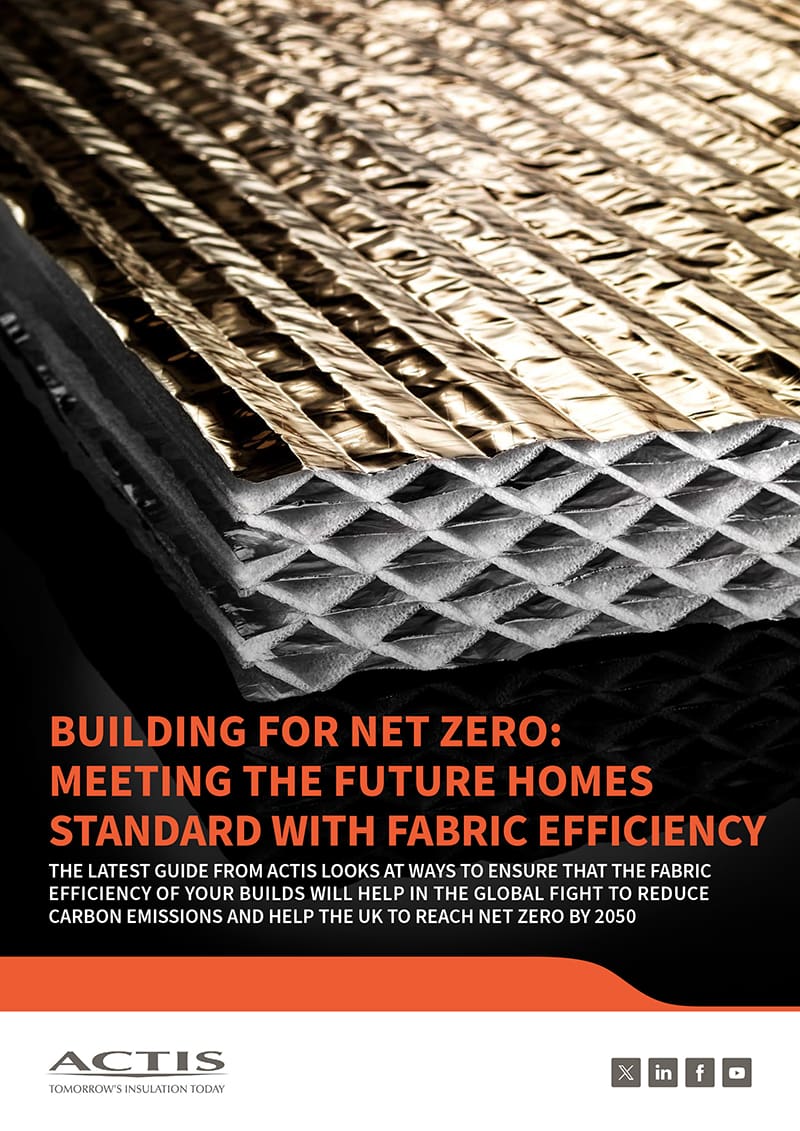


The latest guide from Actis looks at ways to ensure that the fabric efficiency of your builds will help in the global fight to reduce carbon emissions and help the UK to reach net zero by 2050
With the Future Homes Standard coming into force by the end of the year, we’ve joined insulation specialist Actis to look at how to ensure your projects meet the standard’s energy efficiency aims.
Section 2: Training construction professionals for the future
Actis’ role goes beyond designing and creating materials aimed at helping specifiers build the most thermally efficient homes possible. It also aims to educate construction professionals in ways to achieve optimal thermal efficiency via its RIBA-approved CPD modules.
One, Tomorrow’s Insulation Solutions for Future Homes Standards, offers a helpful overview for architects, builders, merchants and building control officers, and is full of technical detail on how to meet both Parts L and O.
The free hour-long CPD has, along with its sister module Addressing the Performance Gap with Reflective Insulation, helped thousands of construction professionals as they wrestle with the complexities of ensuring a thermally efficient new build or conversion.
Between them, the CPDs contain information on thermal modelling psi values to calculate heat loss at junctions, the provision of construction details at both design and as-built stage and the replacement of SAP methodology with the future Home Energy Model (HEM) to calculate energy efficiency.
While full of technical information, the presentations are approachable, with the unexpected use of cupcakes among the visual aids used to illustrate different levels of energy efficiency, for example.
The teatime treats are used to illustrate how to break the net zero target into smaller objectives. A vanilla cupcake represents a minimum thermal value that must be achieved under Part L, while at the other end of the scale, one with coloured icing, sprinkles and mini marshmallows represents a thermal efficiency closer to the Passivhaus end of the spectrum.
They examine the “fabric first” approach, which aims to ensure a building requires less energy to keep warm, how to achieve airtightness without creating condensation and bridging the performance gap through more accountability and transparency.
Delegates also learn about the importance of air cavities to enhance thermal performance when using reflective insulation, various methods of measuring airtightness and the importance of using thermal modelled junctions and construction details when estimating U-values.
For more information or to book a CPD session contact [email protected].
Section 3: The importance of counteracting thermal bridging
One of the aims of Actis’ RIBA-approved CPD Addressing the Performance Gap with Reflective Insulation is to help construction professionals combat thermal bridging.
It includes additional information about thermal modelling and new reflective insulation technologies – products which are particularly useful in reducing thermal transmission of elements – as well as construction details and airtightness.
The free hour-long training session, available online or face-to-face, provides detailed advice on how to reduce thermal bridging and achieve optimal energy efficiency.
As energy efficiency standards should always be based on reducing the need for energy first, with particular focus on limiting the heat loss through thermal elements, reducing thermal bridging and improving airtightness are crucial.
The Actis Hybrid range of insulation and membranes and its two-in-one Eolis HC provide ideal fabric first solutions for the forthcoming Future Homes Standard.
The flexible nature of the products means they can be bent round corners and moulded into gaps to help minimise thermal bridging.
Thermal modelling trials carried out by certification body BM TRADA have shown that Actis insulated membranes have a dramatic impact on counteracting thermal bridging and act as excellent thermal blankets.
The products also address an explicitly stated directive under Part L, which requires insulation to be continuous and thermal bridging to be avoided as much as possible.
The CPD shows how using thermal modelled junctions, such as those available in a library recently updated and augmented by Actis, in conjunction with U-values in SAP (and soon to be HEM) calculations will help ensure projects perform thermally in real life just as planned at the design stage.
Section 4: How to measure U-values easily
Actis’ free U-value simulator tool is proving invaluable for specifiers, building control officers and merchants.
In addition to enabling users to determine U-values of various combinations of Actis products, it can also be used to explore the thermal efficiency of a combination of Actis and generic materials.
With reflective breather membranes now the norm in the timber frame market, the tool includes an option for users to choose from a standard breather membrane, a reflective membrane or Actis Boost R Hybrid in the timber frame wall section of the U-value simulator.
It also includes a feature to help those involved in roof refurb projects, offering an option for either 400mm or 600mm centres.
The tool can also be handy for building control officers to ensure compliance and for merchants, enabling them to work alongside a customer to calculate the U-value of a project.
Experimenting with the simulator would show the specifier or merchant that an installer wanting to achieve a U-value of 0.16 in a timber frame wall, for example, would need 105mm Hybris with H Control Hybrid alongside a generic reflective breather membrane. On the other hand, if they are happy with a U-value of 0.22 they might decide on 125mm Hybris with a generic reflective breather membrane and no H Control Hybrid.
The findings can also be emailed to one of the technical team at Actis who can use the figures to prepare a comprehensive and tailored report to be included in a planning application.
Section 5: How to get maximum thermal efficiency with insulation and membranes
All five Actis products offer builders a quick, clean, easy way to ensure thermal efficiency in their building projects.
All are light and flexible and can be moulded into gaps and can be used in combination with each other or in conjunction with generic insulation and membrane products.
The U-value simulator provides an easy way to determine the thermal outcome in each case.
The four Hybrid products are Hybris, a honeycomb-structured insulation which comes in various thicknesses, insulating vapour control layer HControl Hybrid and two insulating breather membranes – Boost’R Hybrid and Boost Hybrid Roof, the latter of which has a lap and built-in adhesive tape and comes in larger rolls that cover 15 sq m.
In addition, two-in-one a reflective insulation with an integrated vapour barrier Eolis HC, is largely useful for loft and barn conversions and buildings with a shallow pitch where headroom is an issue.
It enables builders and roofers to reduce the number of steps required to achieve an impressive U-value as well as airtightness in roofs.
The Triplex technology on which Eolis HC is based is created from a number of layers of reflective films, each separated by a thin layer of fibre, trapping air between each section, boosting thermal performance.
A series of bite-sized video tutorials shows how to install each of the products in various scenarios.
Section 6: Products as well as practices need to be sustainable
The Francophones among you may be interested in reading a 160-page document produced by Actis’ French HQ which provides details of the sustainability credentials of its products and manufacturing processes.
Those whose prowess at the language falls short of understanding such technical nuances in another tongue can satisfy themselves with the knowledge that such a brochure exists – and underlines Actis’ dedication to be at the forefront of sustainability in the world of construction products.
The PDF brochure, created for the French non-residential market, looks in minute detail at each environmentally friendly element of the production and environmental benefits of its honeycomb-structured Hybris insulation.
The brochure examines Actis’ zero-waste policy, how it designs all its products with their lifecycle in mind, sees all offcuts recovered, broken down, crushed and reintroduced into the manufacturing process and the 100% recyclability of all its materials.
Manufacturing Hybris doesn’t require the high temperatures used by some construction products, which also means energy costs during the production process are reduced.
Minimal water is used during its production and the lightness and compactness of air-filled Hybris means more thermal capacity can be carried per lorryload than traditional solid insulation or fibreglass.
Hybris also produces less waste than many insulation products, not least because of its compressible nature.
In fact, these are among factors that have enabled Hybris to become the only reflective insulation in Europe to have earned international Cradle to Cradle Certified® Certification.
The Bronze level accreditation was awarded by global circular economy organisation the Cradle to Cradle Products Innovation Institute.
These pluses are in addition to the ability of its products not only to keep warmth in during cold weather but also reflect heat during the summer, eliminating the need for gas-guzzling air conditioning.
Specifiers and building control officers in the UK may also be interested in Actis’ Doing More with Less video (in English), which examines its threefold approach to sustainability.
Section 7: Human health must be considered alongside energy efficiency and sustainability
The fact that Actis products are clean to use is one of the oft-heard pluses from builders and installers. The fact that they generate no dust or fibres and require no respiratory equipment are perhaps their most popular attributes among those on the ground installing the products.
Its cleanliness was another of the criteria that helped Hybris achieve the Material Health score in its Cradle to Cradle Certified® Bronze accreditation.
Hybris, in common with all Actis products, contains no volatile organic compounds (VOCs) or harmful chemical components such as formaldehyde, making it safe for human health and the environment.
All five products are also guaranteed non-irritant and classified A+ for indoor air quality according to the NF EN ISO 16000 standard.
Indeed, Hybris has been assessed by chemists and toxicologists to ensure it is safe, as can be seen in the graphic from the Cradle to Cradle Products Innovation Institute.