A multi-award-winning hangar shows how state-of-the-art structural design, precise digital modeling and circular material strategies can transform a historic aviation icon – engineered with ALLPLAN’s integrated BIM workflow
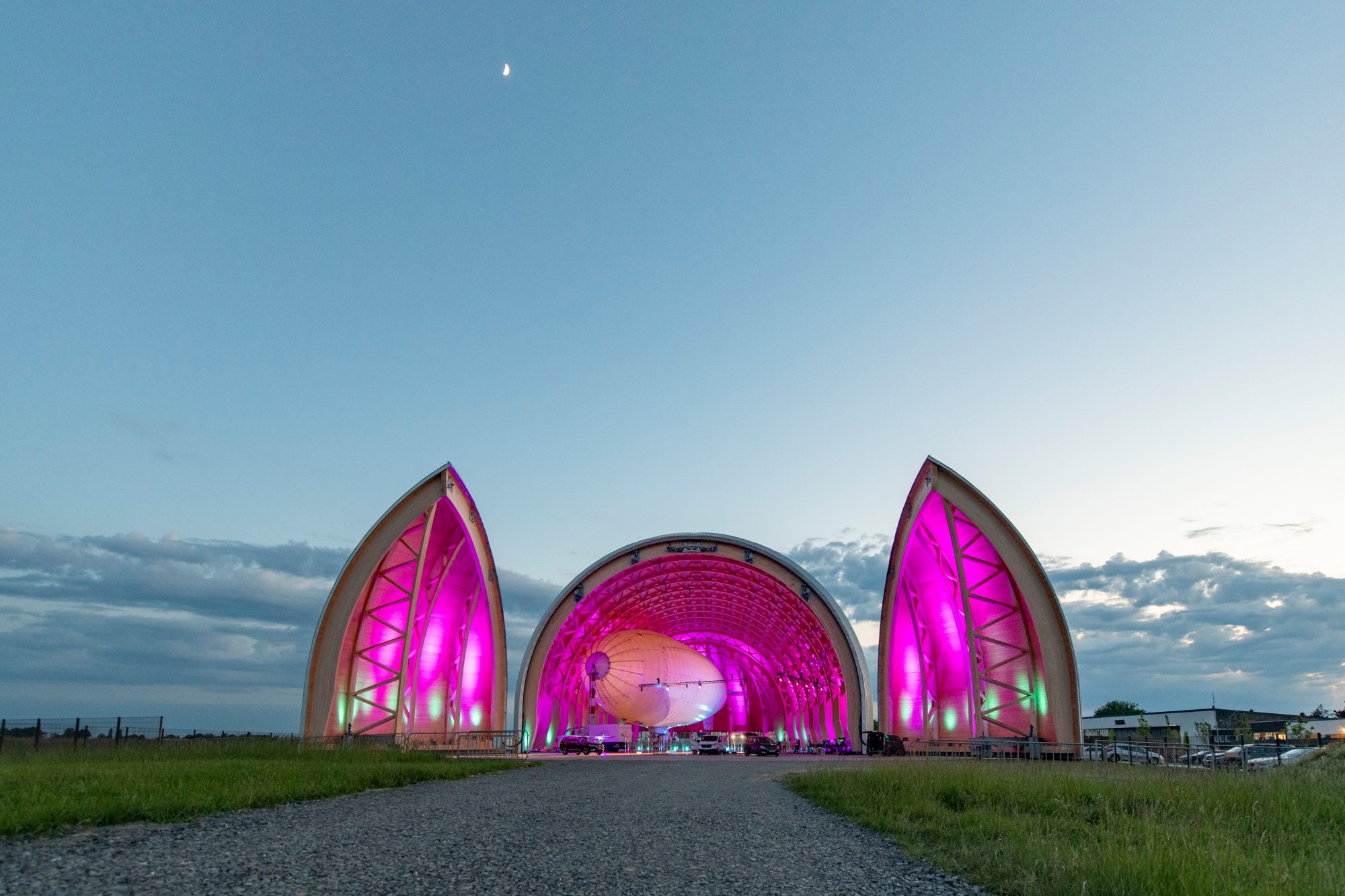
Airships no longer play a major role in air travel, yet they still command attention in the sky as flying billboards. Since the early 1970s, WDL Luftschiffgesellschaft in Mülheim, western Germany, has sustained this niche – and now delivers one of today’s most striking structures: the Airship Hangar Mülheim.
Completed at the end of 2022, the timber hangar replaces a previous lightweight textile hall and serves as a maintenance and winter storage facility. The innovative structural concept was developed by Ripkens Wiesenkämper (structural engineers) using ALLPLAN.
Timber engineering under tight constraints
Authorities granted permission for a replacement structure only, so the footprint and the original curved profile had to be retained. Unlike the old steel hall, the new hangar would be built in timber.
“Using around 557 tons of spruce saved approximately 156 tons CO₂ versus a comparable steel solution.”
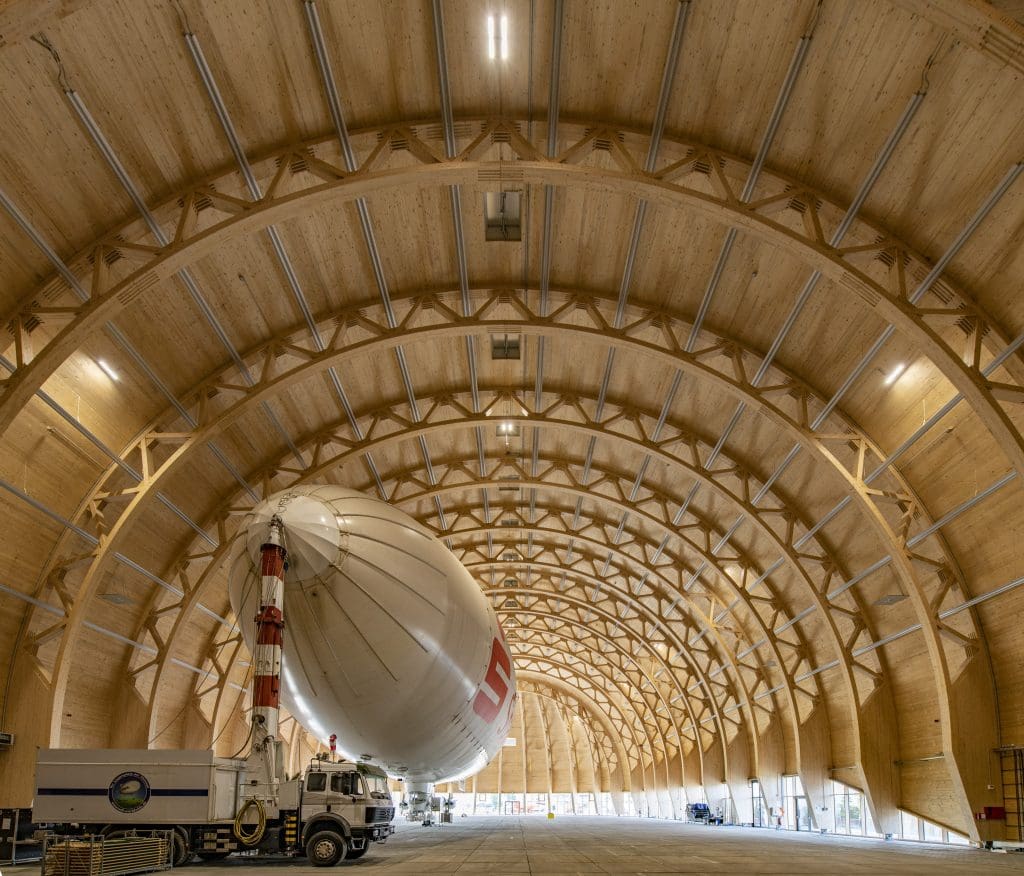
To express an industrial aesthetic with a sense of lightness, Smyk Fischer (architects) chose a truss solution. Ripkens Wiesenkämper, together with Marx Krontal Partner, developed a purely timber truss system that, thanks to nearly 600 engineered timber nodes and beams, requires no steel.
The structure comprises 15 two-hinged arches, each 26m high. Top chords and diagonal members integrate into a cross-laminated timber (CLT) roof shell, while an aluminum standing-seam cladding forms the outer skin.
A standout feature is the double-leaf door. Each 72-ton wing requires precise handling of large movable components. Dr Schippke + Partner delivered the door engineering, combining massive hinges with a guided track system driven by 80-horsepower electric motors.
A benchmark in circular construction
Beyond its distinctive form, the hangar advances sustainable practice. Using around 557 tons of spruce saved approximately 156 tons CO₂ versus a comparable steel solution.
The building also follows circular principles: both the timber frame and the aluminum skin are 100% demountable and designed for reuse or recycling. Components are documented in a building resource passport on the Madaster material database. Several elements are already “second-hand”: the substructure reuses foundations from the previous hall and the floor incorporates concrete slabs salvaged from a former logistics center.
Digital design at full precision
Ripkens Wiesenkämper used ALLPLAN to develop a complete 3D model, including complex connections and other critical zones. The model supported clash detection to resolve conflicts early and underpinned accurate material and cost estimation.
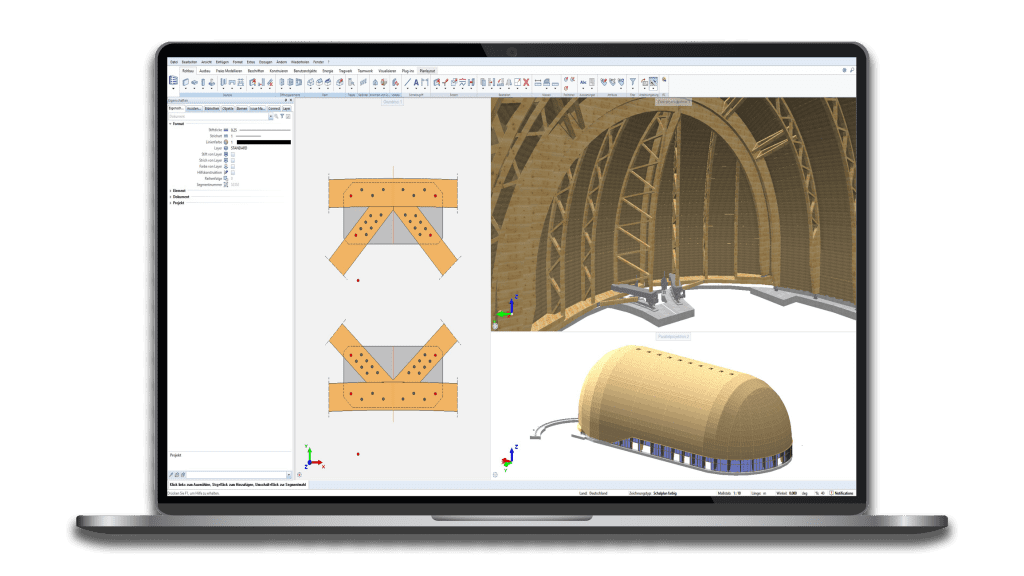
In parallel, the engineers created a reinforcement model for the foundations, enabling precise rebar layout and direct derivation of formwork and reinforcement drawings. Real-time, cloud-based planning allowed multiple designers to work simultaneously in the same ALLPLAN model.
Excellence recognised across the industry
The Airship Hangar Mülheim has become a symbol of innovative, sustainable construction. Honors include the Ernst & Sohn Engineering Award, the Architecture Award, the Timber Construction Award NRW and, most recently, the 2024 German Engineering Award (National Prize).
Moreover, the hangar has proven to be a double win for the city of Mülheim. The city not only gains a highly visible, iconic masterpiece of modern timber construction but also a very special event venue. On days when airships are not in operation, the hall can be used – and, above all, experienced – for events hosting up to 1,500 people.