

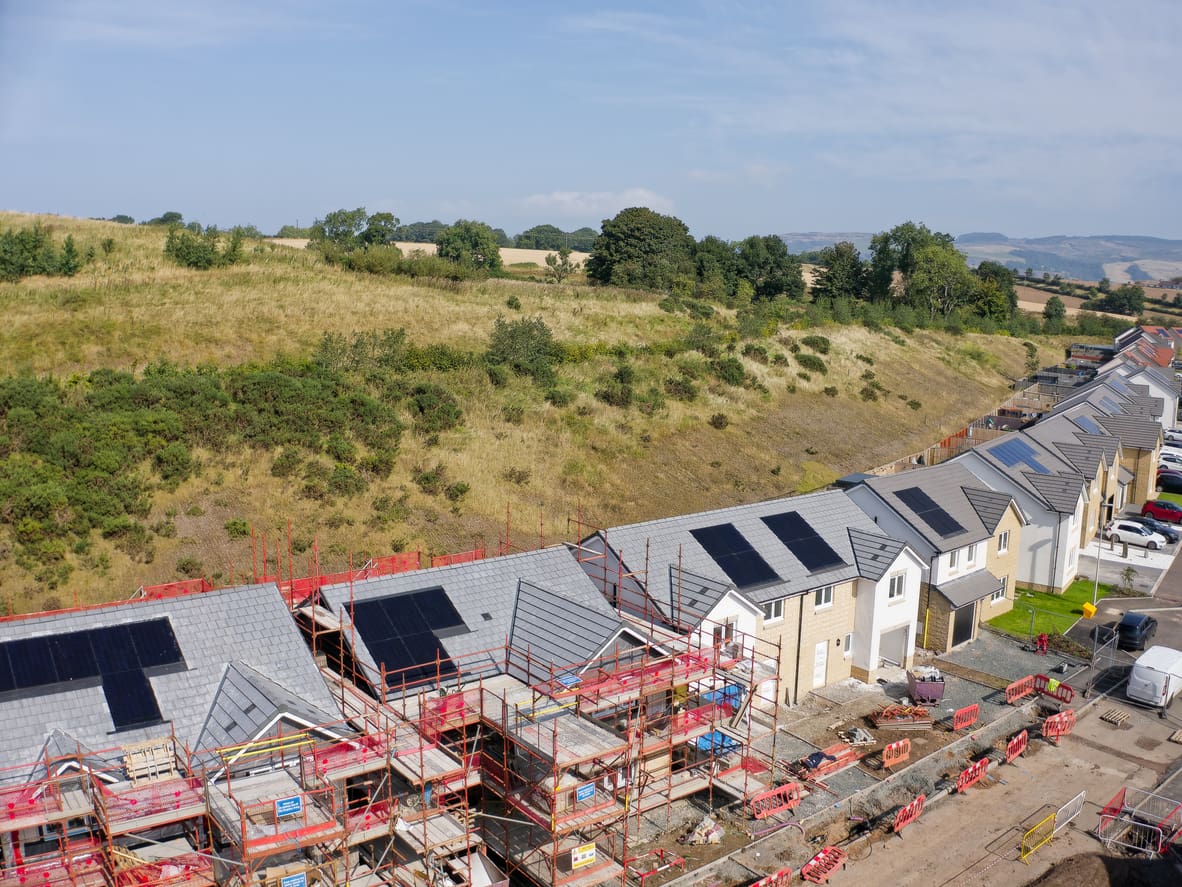
The government has launched a consultation period on the latest draft revisions of the National Planning Policy Framework
The government is seeking input on the latest version of the National Planning Policy Framework(NPPF), with the 123-page document presenting 225 questions on changes to UK planning policy designed to support the infamous 1.5 million homes target. The consultation period is open until 10th March 2026.
Housing secretary Steve Reed commented:“Right now we see a planning system that still isn’t working well enough. A system saying ‘no’ more often than it says ‘yes’ and that favours obstructing instead of building. It has real-world consequences for those aspiring to own a home of their own and those hoping to escape so-called temporary accommodation – we owe it to the people of this country to do everything within our power to build the homes they deserve.
“We’ve already laid the groundwork to get Britain building but our planning overhaul was only the first step to fix the housing crisis we face. And today I’m going further than ever before to hit 1.5 million homes and place the key to homeownership into the hands of thousands more hardworking people and families.”
Industry reactions to the NPPF revisions have been largely positive
Many of the NPPF’s proposed changes have already been announced, such as favouring planning applications for housing near railway stations and high rise residential blocks in urban areas; relaxing biodiversity net gain rules for smaller developers and expanding the Building Safety Levy exemption threshold from sites with 10 homes to a 50 homes limit.
Industry reactions have largely welcomed the revisions, although questions about actual delivery of housing and balancing environmental concerns with planning demand remain.
Increased support for SME builders has been long-called for
Brian Berry, chief executive of the FMB said:
“The nation’s small housebuilders need to regain a foothold in the housing market, and the Government planning reforms are a positive push in the right direction to enable this to happen. For medium planning sites the reforms will help SMEs grow their businesses. Getting to the ambitious 1.5million new homes target will require a joint push from the entire housing sector to achieve it and diversification of the housing market will be essential to ensure this happens.”
“While the announced improvements help, smaller developers need well-staffed and dynamic planning teams, achieved through a boost in staff numbers or the use of innovative technology to support the process. Technical changes to planning will only ever go so far before funding becomes the main barrier which stalls sign offs. This is something the Treasury needs to understand and inject more cash to overcome a crumbling planning system.”
Matthew Evans, partner (Planning), Forsters law firm, said,
“Steps to simplify the planning process are always welcome. Shifting to a more rule-based system that will remove ambiguity for developers and local authorities should streamline the process and deliver more homes, more quickly. Making use of brownfield land around train stations is logical, but it is also costly and at a time when viability is constrained it will be interesting to see how quickly headway is made on the delivery of new homes in these locations.
“The planning system is complex and time-consuming, which so often locks out SME housebuilders, it is therefore positive to see the introduction of a proportionate system for sites of less than 49 homes. The planning reform that the Government has rolled out so far seems to be having a material difference on the ground.”
Planning is about more than approvals, caution some – action to actually deliver homes is needed
Magnus Gallie, senior planner for Friends of the Earth, said:
“The government needs to focus on getting homes built on sites that already have permission, rather than releasing greenbelt land to hit housing numbers.
“The problem is not that the planning system is blocking homes – last year over 75% of housing applications were approved. The real issue is that private developers alone cannot deliver this scale of housebuilding. Continually tinkering with national policy while under-resourced councils are pushed to approve applications will not fix stalled delivery.
“Steps to improve housing resilience to climate change and stop development from contributing to the extraction of more fossil fuels are welcome. But the government needs to go further; especially in supporting the delivery of more social and affordable homes.
“Good planning is so much more than hitting targets – it’s about creating thriving communities with access to jobs, schools, healthcare and green space, in homes that are warm and genuinely affordable. Constantly moving the goalposts to favour housebuilders risks unbalancing the social, environmental and economic foundations of well-planned communities.
Ben Standing, partner in planning at UK and Ireland law firm Browne Jacobson, said:
“It’s clear that with the government putting its pledge to build 1.5 million homes at the heart of its economic growth ambitions, it’s pulling on every lever it has control over by making sweeping changes to environment regulations and planning policy.
“The latest consultation on an amended NPPF – which comes just a year after publishing a revised version – brings forward significant changes to how planning decisions are made by local and national government.
“In particular, there is a targeted push to unlock small and medium-sized plots of land for development by creating a new ‘medium’ category for sites, exemptions for smaller sites from biodiversity net gain regulations and new benchmark land values.
“These are often regarded as the most difficult sites to bring forward for development due to land costs and local opposition. While the government wants to introduce a permanent presumption in favour of suitable development, it must be mindful of how councils and developers engage communities early on so that valid concerns are mitigated ahead of construction work. This can ensure local people feel they are benefitting, not suffering, from national development targets.
“More broadly, there is a danger that constant planning policy flip-flopping actually holds back development rather than accelerates it. In our experience, regular significant changes to the system creates uncertainty for developers on how to cost these in, while local authority planners require sufficient guidance so they can make good decisions.
“Planning policy will only ever be one piece of the jigsaw in the government’s quest to build more homes. It must address the viability problem by tackling the wider economic and skills challenges that make construction so expensive.”
However, concerns about the grey-built policy remain
CPRE chief executive Roger Mortlock said:
“There is lots to welcome in this draft revision to the National Planning Policy Framework, not least a focus on urban densification, a recognition of the importance of rural affordable housing, and welcome support including targets to encourage more SME builders.
“However, any brownfield-first approach needs teeth. Brownfield targets are still missing. Our research shows that there is room for at least 1.4 million homes on brownfield sites in England alone.
“Our main concern remains the rise of speculative development in the countryside, especially in rural local authorities that have seen a massive increase in their housing targets. Already, every year since 2019, the UK has lost 3,800 acres of countryside on average – equivalent to the footprint of a small city.
“We are wary of any automatic green light for development in the countryside, including in the Green Belt where the government’s ill-defined “grey belt” policy isn’t working. Our research shows that the vast majority of new homes approved on ‘grey belt’ sites will be built on unspoilt countryside, not the disused petrol stations and car parks the government promised last year.”