
Discover how construction and contracting companies can boost their workflow efficiency with reality capture technology
Of all the slogans offered to jumpstart a year, “new year, new you,” must rank high on some official list. But cliches exist in part because they’re shorthand for simple truths. In early 2026, millions of Britons will, in effect, embrace a form of “new year, new you.”
Many will fail. But many will succeed.
The good news is that companies, too, can commit themselves to the “new year, new you,” mantra.
Take, for example, construction and contracting firms as they embrace new technology to make them smarter, more agile, and better equipped to close old business, while embracing new opportunities.
Increasingly, reality capture solutions are the collective hardware and software tools helping achieve those aims.
Wulverhorst: Built from the ground up
Wulverhorst, a Dutch construction and contracting firm, is but one example of a company doing just that.
With an emphasis on design-and-build integration, Wulverhorst manages both the creative and technical aspects of projects, ensuring efficiency, consistency, and high-quality execution from concept to completion, combining craftsmanship, project management expertise, and long-term client relationships to deliver tailored solutions that reflect each client’s brand and operational needs.
But Wulverhorst is not alone. Many brands are making the laser scanning leap. And with a little foresight and planning, yours could be next.
Employing reality capture tech
If Wulverhorst is a template, many construction companies begin their laser scanning journey by adopting increasingly sophisticated digital reality capture solutions.
First to measure and document jobsites. Then, to project plan their client’s work, starting with off-the-shelf 360° cameras and soon after, by joining the FARO Sphere® XG Digital Reality Platform, while also upgrading to the FARO® Blink™ Imagining Laser Scanner in an effort to have a complete end-to-end solution.
Sphere XG allows teams to document and visualise jobsites over time with 360° cameras, then upload and pin those photos to digital floor plans. The result is a virtual walkthrough of the entire site, accessible remotely to owners, general contractors, and other stakeholders.
With it, users could take consistent photo captures, automatically sync them to the cloud, and track progress through a visual timeline that showed exactly how a project evolved day by day. This made it far easier to verify work completion, resolve disputes, and reference hidden infrastructure before walls were closed.
Blink: From data to deliverables
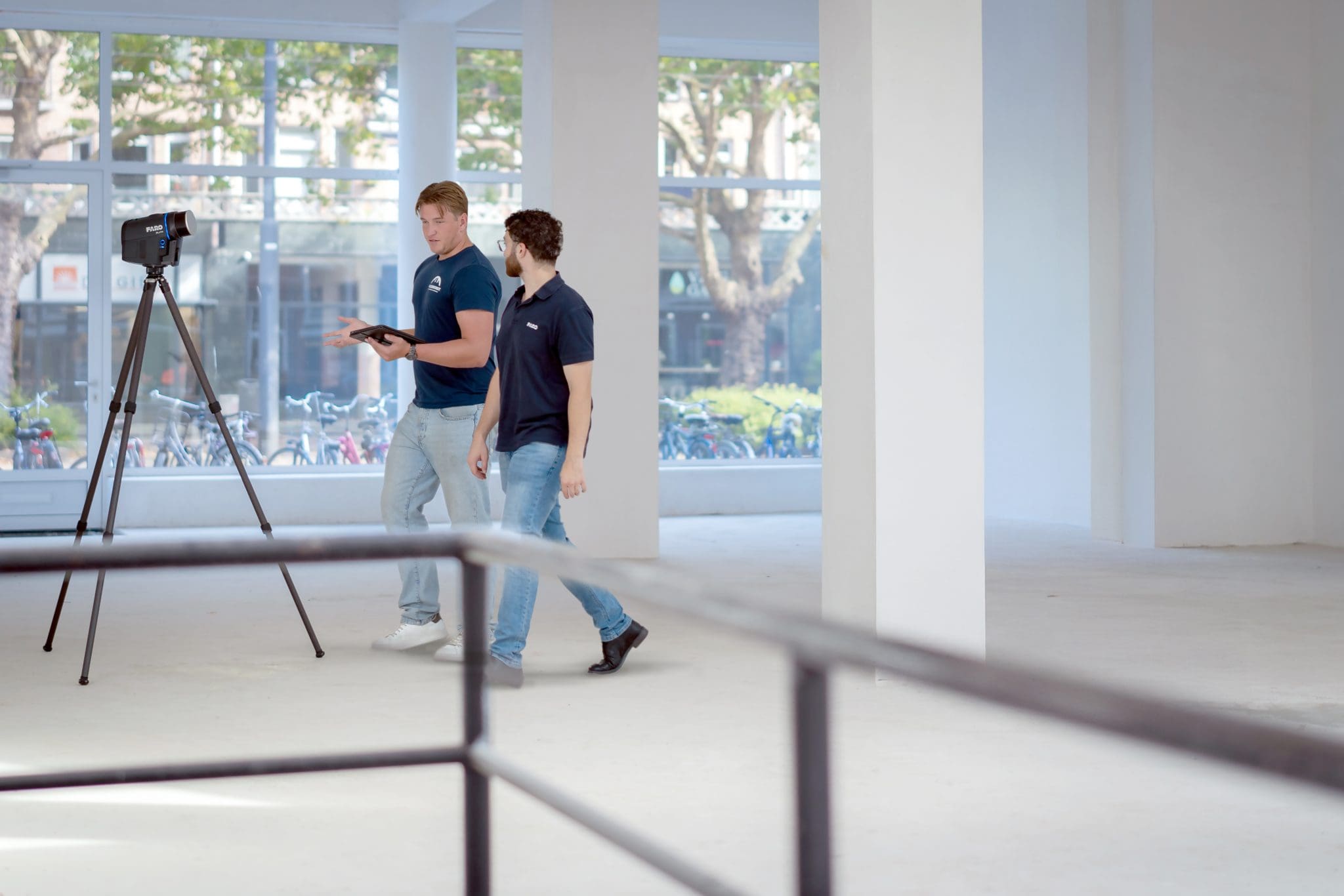
At the core of Blink’s appeal is the device’s simplicity and ease of use. With one-button operation, real-time guidance (via app or device indicators) and automatic registration of scans, Blink allows users to collect high-quality data quickly and reliably.
Best of all is that if you’ve never scanned before, users are in for a treat. Blink will tell you if you’ve moved out of position or if you’re about to scan in the wrong location.
This intuitive, guided scanning process makes laser scanning easy for everyone, from beginners to seasoned pros.
Of course, detail and data are what matter most.
The scanner captures HDR 360° photos of up to 50 MP and 3D point clouds withprecision up to 4 mm at 10 m and supports up to 50 million points per scan with a range up to 80 meters.
Once captured, the data is processed and uploaded into Sphere XG, enabling remote collaboration, extraction of orthophotos, actionable insights, and the ability to address customer needs, faster – a dynamism and responsiveness clients increasingly seek.
For many, Blink can do what off-the-shelf 360° cameras and LiDAR-based smart devices cannot: effortlessly combine market-leading ease-of-use and extremely high-quality photos with an embedded point cloud.
With improvements like these, companies can expect to see impressive workflow efficiency gains requiring fewer jobsite return visits, thanks to greater accuracy in floor plans and the ability to detect structural and alignment errors in superior detail.
This time saving has a positive knock-on effect, freeing up companies to pursue new business faster, shift funds accordingly (including marketing efforts) and in general, remain at the top of their game.
Words of wisdom
To be sure, there are always considerations.
If there is any stumbling block in the journey toward Blink, it could be the investment itself.
After all, upgrading from an off-the-shelf camera to Blink, which includes point cloud generation, requires upskilling, as well as gaining basic familiarity with the device.
While Blink is a significant investment compared to a standalone 360º camera, it is priced competitively relative to the 3D laser scanning market. Moreover, the benefits companies stand to gain offset any initial purchase price jitters.
Thus, in 2026, as both people and companies commit to new ways of accomplishing tasks and achieving goals, 3D laser scanning solutions are fast becoming the digital change agents that construction and contracting firms increasingly seek.
New year, new you?
100%!
*Please note that this is a commercial profile.