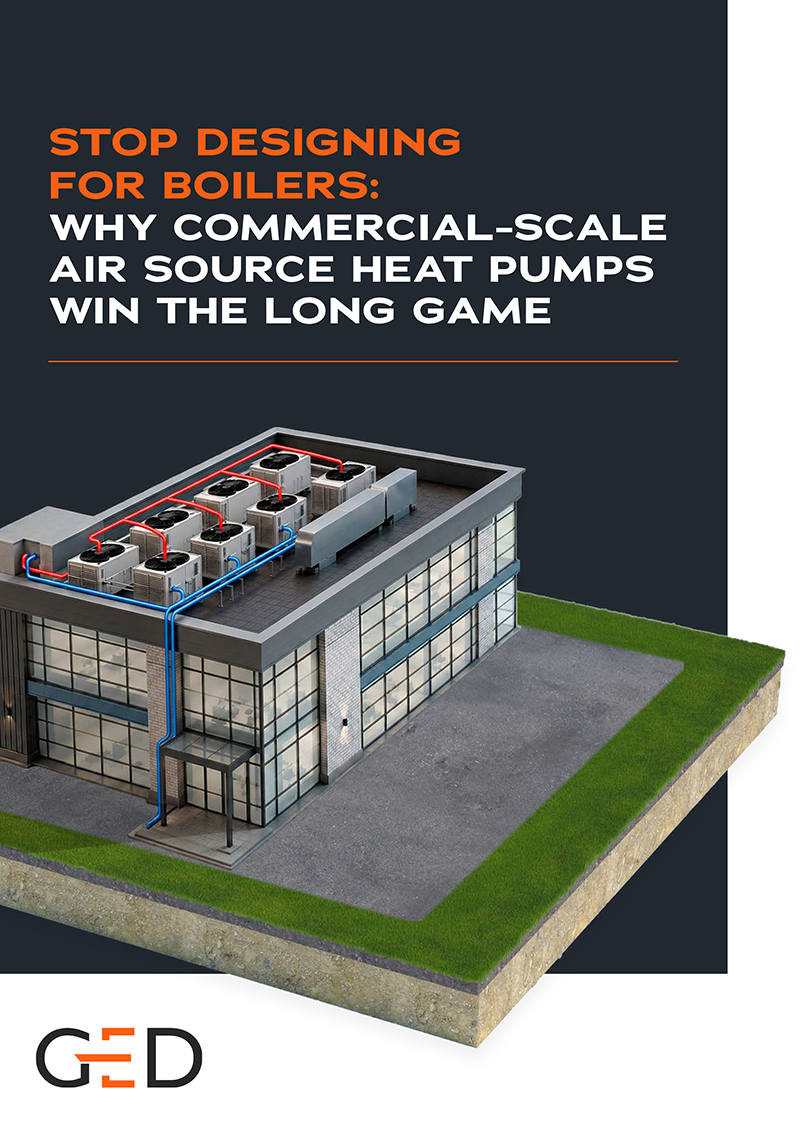


GeoEnergy Design‘s latest eBook discusses why developers must shift their mindsets when it comes to air source heat pumps
Not long ago, during a conversation with a prospective heat pump client, I was asked a familiar question: “Sell me the attributes of an air source heat pump.”
It is a reasonable request. In a marketplace crowded with technologies, policy shifts and competing claims, decision-makers are understandably cautious. They want clarity. They want confidence. They want to know why change is necessary.
But instead of answering directly, I turned the question around.
“Before we do that,” I said, “why don’t you sell me the attributes of a fossil fuel boiler?”
There was a pause.
A shift in perspective
After a moment’s reflection, the client began to think aloud — reliability, perhaps familiarity, maybe lower upfront cost. But as he spoke, each point seemed to weaken under scrutiny. Volatile fuel prices. Carbon emissions. Regulatory uncertainty. Long-term obsolescence. Exposure to policy risk. Increasing scrutiny from lenders and ESG reporting frameworks.
Eventually, he stopped.
“Actually,” he said, “I can’t.”
Then, almost quietly: “OK. Let’s go forward with the heat pump.”
The exchange was simple, but it revealed something important. Sometimes progress does not require a hard sell. It requires a shift in perspective. When we examine what we are holding on to — and why — the case for change often becomes self-evident.
That perspective shift is exactly what is required when discussing commercial scale air source heat pumps (ASHPs), particularly systems from 45kW upwards.
The real question
When objections are raised against air source heat pumps, they often follow a predictable pattern:
“They’re expensive.” “They struggle in winter.” “They need bigger emitters.” “They don’t deliver boiler temperatures.” “They require storage.”
But are these technical flaws — or signs that we are still designing buildings around 20th century combustion assumptions?
A heat pump does not struggle because it prefers 45C to 65C. It is simply more aligned with thermodynamics.
It does not require storage due to weakness. It benefits from stability.
It does not fail because it runs continuously. It performs best because it does.
The friction we feel is cultural, not technical. For decades, fossil fuels allowed us to design inefficient, oversized, high-temperature systems without consequence. Electrification removes that margin.