

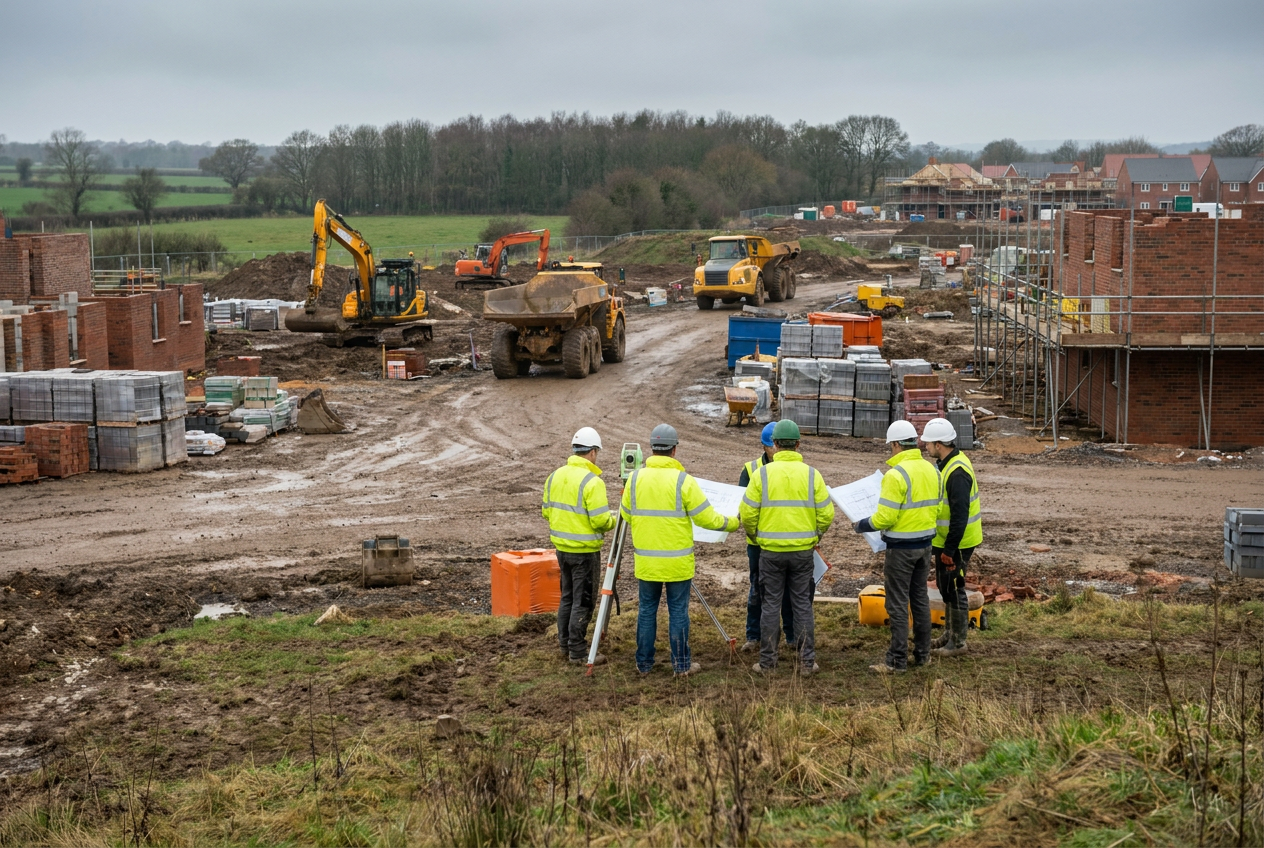
The UK government’s newly unveiled ‘grey belt’ strategy aims to release poor-quality Green Belt land for development to meet a mandatory target of 1.5 million new homes over this Parliament
While this policy shifts the planning bottleneck, it places immediate pressure on technical auditing and structural warranty providers to ensure these often contaminated or complex sites meet long-term insurance standards. Developers must now balance the speed of land release with the rigorous compliance demands of modern building regulations and lender requirements.
What is the ‘grey belt’ and how will it affect planning?
The ‘grey belt’ is defined by the government as land within the Green Belt that has been previously developed or consists of “low-quality” areas, such as disused car parks, derelict sites, or land that makes a limited contribution to the five Green Belt purposes.
By reclassifying these areas, the Ministry of Housing, Communities and Local Government (MHCLG) intends to bypass traditional planning stagnation, provided that developments meet a “golden rule” of 50% affordable housing.
For property developers, this represents a significant opportunity to secure land in high-demand areas. However, the transition from a derelict site to a viable residential scheme involves substantial latent defect risks. A structural warranty—a 10 or 12-year insurance policy that protects against major defects in the design, workmanship, or materials of a new build—becomes the critical gateway for project viability on these sites.
How does land reclassification impact structural risk?
Building on previously developed land, particularly the industrial or neglected sites targeted by the grey belt strategy, presents unique engineering challenges. Issues such as ground contamination, unstable soil conditions from prior foundations, and drainage complexities are frequent. Unlike pristine greenfield sites, grey belt locations require intensive technical auditing early in construction to prevent future structural failure.
Build Warranty is currently seeing a notable market trend: an increase in site insurance queries for complex brownfield and grey belt remediation projects. The company’s technical team notes that while planning may be faster to obtain, lenders’ technical sign-off is becoming more stringent to mitigate the risks associated with non-standard land.
“The reclassification of land does not change the laws of physics or the requirements of the Building Safety Act 2022,” says Andrew Dyson, Cert CII, CEO of Build Warranty. “While we welcome the government’s move to unlock land, developers must recognise that faster planning does not equate to a lower bar for structural integrity. In fact, grey belt sites often require a more robust technical audit trail to satisfy insurers and lenders who are increasingly cautious about long-term latent defects on reclaimed land.”
Why is technical auditing critical for grey belt schemes?
Technical auditing is the process of independent site inspections conducted by warranty providers to ensure the build complies with approved standards and insurance requirements. On grey belt sites, these audits are essential for identifying risks such as sulphate attack in foundations or settlement issues that could lead to multi-million-pound claims years after completion.
Build Warranty’s internal data shows that sites with complex ground histories account for a disproportionate number of technical queries during the substructure phase. Without early engagement with a warranty provider, developers risk reaching the completion stage only to find their primary structural insurance withheld because they lack sufficient evidence of ground remediation or foundation compliance.
Key takeaways for developers:
- Early engagement: Instruct Build Warranty at the feasibility stage to ensure site remediation plans meet structural warranty criteria before breaking ground.
- Rigorous documentation: Maintain exhaustive records of groundworks and foundation designs on grey belt sites to satisfy the heightened scrutiny of technical auditors.
- Lender compliance: Ensure your chosen warranty provider is widely accepted by UK mortgage lenders, as non-standard land developments face stricter financial sign-off.
- Integrated insurance: Utilise comprehensive site insurance to protect against unforeseen environmental or structural issues during the high-risk remediation phase of grey belt projects.
Questions developers are asking:
Does grey belt status exempt a project from standard biodiversity net gain requirements?
No, developers must still comply with statutory biodiversity net gain (BNG) and environmental standards, which often adds complexity to the site layout and drainage design.
Can I secure a warranty for a site with known contamination history?
Yes, provided a technical auditor approves a full remediation strategy and a Build Warranty professional inspection regime verifies it.
As the government moves to implement the National Planning Policy Framework (NPPF) revisions, the industry must keep its focus on quality and compliance.
The speed of the grey belt rollout will likely be determined not by the planning office, but by developers’ ability to demonstrate that these new homes are safe, durable, and fully insurable. Developers reviewing their warranty arrangements ahead of these changes should speak to Build Warranty to ensure their projects remain on track for successful delivery.