

Sebastian Chucas, offsite & modular key account manager, ROCKWOOL Core Solutions, explains why traditional practices need reform to meet the ever-changing regulations of the Building Safety Act, and why offsite construction could be the answer
Since it was introduced in 2022 – in the wake of the Grenfell Tower tragedy – the Building Safety Act has redrawn the lines of accountability across UK construction. By 2027, its requirements are expected to become more exacting. For dutyholders, meeting the regulations is now only half the task; the other half is proving it. Throughout a project’s life, you must record who did what, where, and when, long before the first brick is laid.
This is where the Golden Thread of information plays a critical role, tracking compliance from the start.
The Gateways leave no room for late fixes
Under the Gateway regime, evidence must be presented at two pivotal points: before construction begins (Gateway 2) and before occupation (Gateway 3). Some approvals take up to 12 months, and a weak or incomplete submission can halt a project or force an expensive redesign late in the day. Compliance must be settled at the design stage.
Offsite systems address this directly. Because they are designed, engineered, tested and documented under factory conditions, much of the evidence a Gateway submission requires is produced as a by-product of manufacture. It describes the system actually being built rather than a theoretical specification open to interpretation.
As Dido Graham, associate & project architect at Willmore Iles Architects, puts it: “The self-contained nature of the offsite system where fire safety, airtightness, and structural performance are guaranteed at assembly makes the evidence package we need to compile more straightforward.”
Taking variability out of the equation
Most building safety engineers will tell you that risk on a conventional project inflates when design intent meets site workmanship. Each additional follow-on trade introduces another variable.
Precast concrete shows the alternative. Virtually all precast produced in the UK is covered by an ISO 9001 quality management system, and dedicated material suppliers and quality moulds deliver consistent output. Fire, acoustic and structural performance are fixed at design stage and reproduced reliably on site. When stone wool insulation is incorporated into precast panels during production, the inconsistencies of multi-trade assembly on site are removed. Competent installation and oversight remain essential, but dutyholders start from a far stronger evidential position.
Stone wool also helps performance hold up over time, keeping indoor temperatures consistent and reducing heating and cooling demand. Its internal structure is not subject to thermal drift, so unlike many insulation products that degrade over time, it maintains its performance for the building’s lifetime. That matters for Passivhaus projects, where targets must remain achievable long after handover, and it complements the inherent durability of concrete. Faster on-site installation also shortens the period during which the building is exposed to uncontrolled conditions.
In practice: University of Exeter
A forthcoming student accommodation scheme at the University of Exeter, targeting certified Passivhaus and using a factory-manufactured precast concrete panel system, shows how manufacturing and digital information can combine to create a repeatable, Gateway-ready methodology.

Every panel is assigned a unique QR code during production, enabling photographs and quality records to be logged directly against each component. Manufacturing data, test records and quality assurance information can be retrieved for any component at any time. If a performance issue ever emerges, the responsible suppliers and product details are immediately identifiable. This criterion is perfectly suited to the Building Safety Act, ushering in a new era of traceability.
For the design team, that certainty is the point. Tim Abram, director at Willmore Iles Architects, notes that in traditional builds, Passivhaus “relies heavily on every trade performing to near perfection. With offsite construction, that level of quality is already built in, not left to chance on site.”
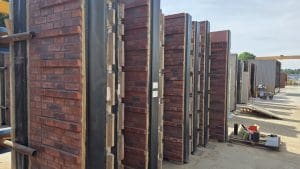
Student housing also raises the stakes on programme. Schemes are tied to academic intakes, and a late handover can mean losing an entire year’s cohort, with serious financial consequences. Manufacturing components in parallel with site preparation protects that timeline. Many such projects are financed on 50-year concession models, so longevity is critical. A well-built precast structure can last 100 years or more, and stone wool insulation retains its thermal performance throughout.
Ready for what comes next
The regulatory landscape will keep evolving. Guidance and secondary legislation will continue to develop beyond 2026, and the new sole Building Safety Regulator will roll out a comprehensive three-year strategic plan from 2027. Developers must also prepare for the Building Safety Levy, which comes into force on 1 October 2026. It is a government tax on new residential developments that will help fund the remediation of fire safety defects, and it will add cost and complexity to some schemes. Offsite cannot cancel out those costs. However, less rework and fewer hold-ups at Gateway stages improve overall efficiency and free up investment for where it counts.
The Building Safety Act points the industry in the right direction. Offsite construction is not a complete answer on its own. Where it delivers consistency, repeatable quality and clear evidence, though, it gives dutyholders a credible way to meet the standards the new regime now expects.