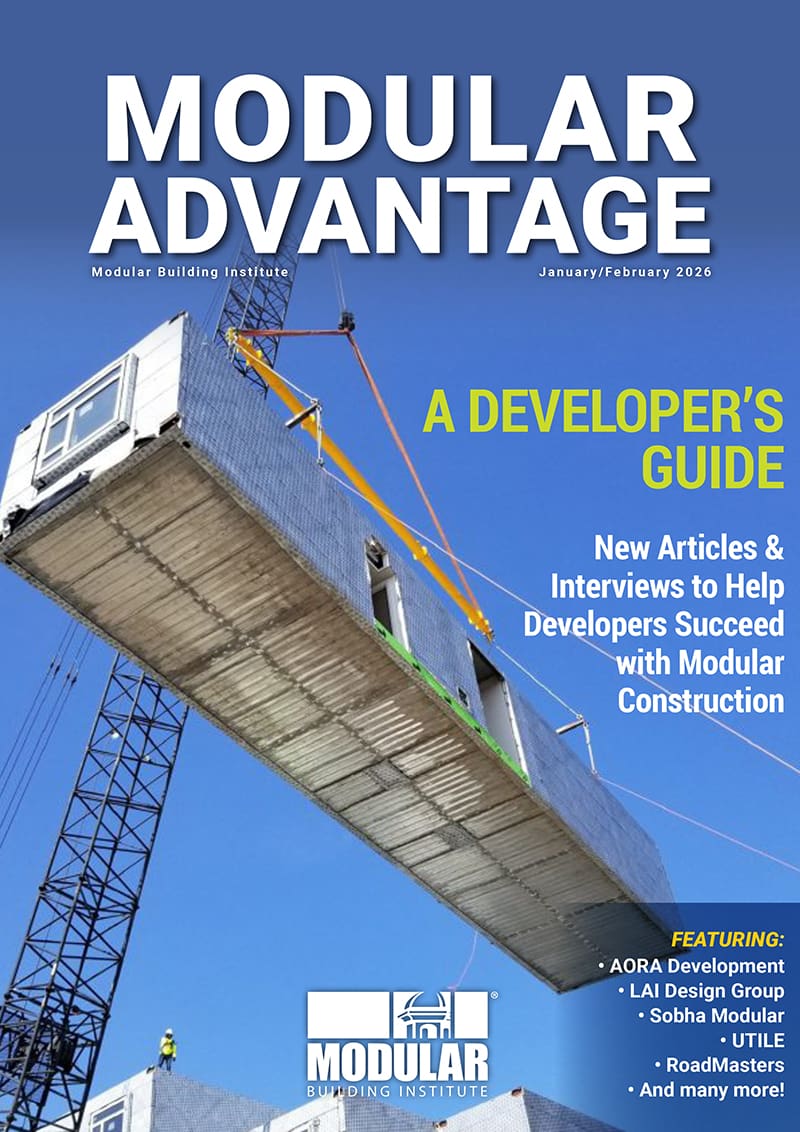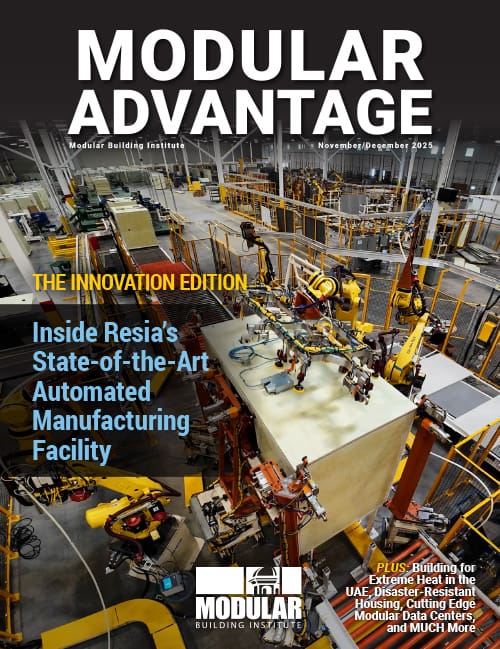


Modular Advantage returns for its September/October edition, with important announcements from Pro Vision Design, LLC, and Murray Engineering
Exclusive insights from Assemblage Works, Inc. and another update on World of Modular Europe 2026 also feature, along with:
- Rules, Rails and Repeatability: Applying DfMA to Modular Healthcare – Christopher Flass, Integrated Design Cubed, LLC
- Catch It in the Factory, Not in the Field: Smarter Testing for Modular Builds – Eric Watters, RDH Building Science Inc.
- Modular Construction Contracts: Key Considerations for Successful Canadian Projects – Max Gennis and Matt Gaulton, WeirFoulds LLP
- Lessons from Hospitality and Student Housing Projects Across the United States, Europe, and Asia – Kris Droszcz, Rebel DFMA LLC
- Repeatability Begins with Trust: What Alora at Dry Creek Reveals About Scaling Modular Housing
And a letter from the board chair:
Dear members and colleagues,
THE SUCCESS OF ANY MODULAR BUILDING BEGINS LONG BEFORE THE FIRST MODULE ENTERS PRODUCTION. It begins with a design that recognizes how the building will be manufactured, transported, assembled, and completed. That is the purpose of design for manufacturing and assembly, or UMA, and it is becoming increasingly important as our industry grows.
DAMA requires project teams to think beyond whether a buliding can be constructed. They must consider how it can be constructed efficiently,
repeatedly, and with fewer opportunities for deley. Decisions involving structural systems, module dimensions, material selection, buiking services, connections, transportation, and installation must support both the architectural vision and the realities of factory production
This is why professionals who specialize in DIMA bring such tremendous value to modular projects. They help connect architects, engineers, manufacturers, contractors, and owners during the earliest stages of planning. Their experience can identify potential conflicts before they reach the production line, simplify complex assemblies, improve factory flow, and protect the project’s design intent They also help teams strike the right balance between standardization and the flexibility every project requires.
As digital design tools, building information modeling automation, and artificial Intelligence continue to advance, DMA will become even more powerful. Technology can help us evaluate options faster, improve coordination, reduce material waste, and create modular systems that can scale across projects and markets. But technology alone is not enough. We still need knowledgeable professionals who understand both design and manufacturing and who can bring every project stakeholder to the table early.
I look forward to continuing these conversations at World of Modular Europe, taking place in Amsterdam, October 12-14. Now in its third year, the conference will bring together modular designers, manufacturers, and stakeholders of all kinds from Curope, Asia, the Americas, and beyond to share ideas, develop partnerships, and explore new opportunities for our global industry.
In the meantime, encourage everyone to prepare their best projects, products, and marketing work for MD Awards of Distinction contest, which is now open. Every entry helps demonstrate the creativity, quality and growing capabilities of both our membership and of the entire commercial modular construction industry.
I hope to see you all in Amsterdam!
Matt Slataper
Chair Board of Directors
Modular Building Institute