

Challenges and Opportunities for the Construction Industry
Executive Summary
The Building Safety Act (BSA) of 2022 is transforming how the UK construction industry approaches safety, accountability, and compliance. Born from the Grenfell Tower tragedy, the legislation introduces a framework of duty holders, new approval “gateways,” and a requirement for a continuous record of information, known as the “golden thread.” While implementation has been challenging – approval delays, unclear feedback, and resource constraints – the Act ultimately offers an opportunity to elevate standards and embed a culture of responsibility across the industry.
This white paper analyses the Act’s key provisions, highlights practical challenges shared by leading practitioners, and outlines actionable recommendations for construction firms, clients, and regulators. By investing in information management systems, developing clear compliance strategies, and fostering early client engagement, organisations can turn compliance into a driver of long-term resilience and trust.
Introduction
The BSA marks a seismic shift in the UK’s construction sector. Its purpose is to ensure such a tragedy as Grenfell – where accountability failures led to catastrophic consequences – never happens again. The Act introduces wide-reaching reforms that impact design, construction, and occupation of buildings. Far from being limited to high-rise residential towers, it applies to nearly all projects, from small refurbishments to large-scale developments.
The reforms aim to resolve longstanding issues of ambiguity, fragmented responsibility, and inadequate record-keeping. Yet, adoption across the industry has been uneven, with many stakeholders struggling to interpret requirements and adapt business processes. At the same time, the Act creates an opportunity to strengthen collaboration, build public confidence, and future-proof the built environment.
Core Provisions of the BSA
Gateways
The Act introduces three checkpoints:
- Gateway 1- Planning: Ensures safety is considered from the earliest design stage.
- Gateway 2 – Pre-construction: Requires approval of detailed designs before building work begins.
- Gateway 3- Completion: Validates that construction meets approved safety requirements before occupation.
These gateways prevent unsafe practices from advancing through the lifecycle of a project. However, they have also become a bottleneck, particularly at Gateway 2, where approval times now average over 18 weeks instead of the statutory 8–12 weeks. As Matthew Ayres, Partner at Simpson Haugh, noted, “We’ve got to demonstrate that what we’re doing is appropriate, rather than relying on a sign-off from building control.” Later, reflecting on the ongoing uncertainty, he admitted, “It does feel a bit of a roller coaster at the moment, but hopefully we’ll all get more savvy about what we’re doing and how we’re doing it.”
Duty Holders
Every stakeholder – from clients and designers to contractors and subcontractors – is explicitly assigned responsibilities. A new role, the Building Regulations Principal Designer, brings accountability for compliance directly into project teams. Festus Moffitt of John Robertson Architects explained, “You brought that inside the team… the Principal Designer is there to act as a sounding board for compliance.” But he also cautioned that without clearer responses from regulators, “design teams risk stabbing in the dark, leading to uncertainty and delays.”
Stakeholder Responsibility Map
| Client | Principal Des. | Contractor | Sub-contractor | Regulator | |
| Design Comp. | ✅ | ✅ | ✅ | ||
| Record-Keeping | ✅ | ✅ | ✅ | ✅ | |
| Safety Signoff | ✅ | ✅ | ✅ | ✅ | |
| Change Ctrl | ✅ | ✅ | ✅ | ||
| Liability | ✅ | ✅ | ✅ | ✅ |
Figure 1: Clear responsibilities under the BSA ensure accountability across all stakeholders.
The Golden Thread
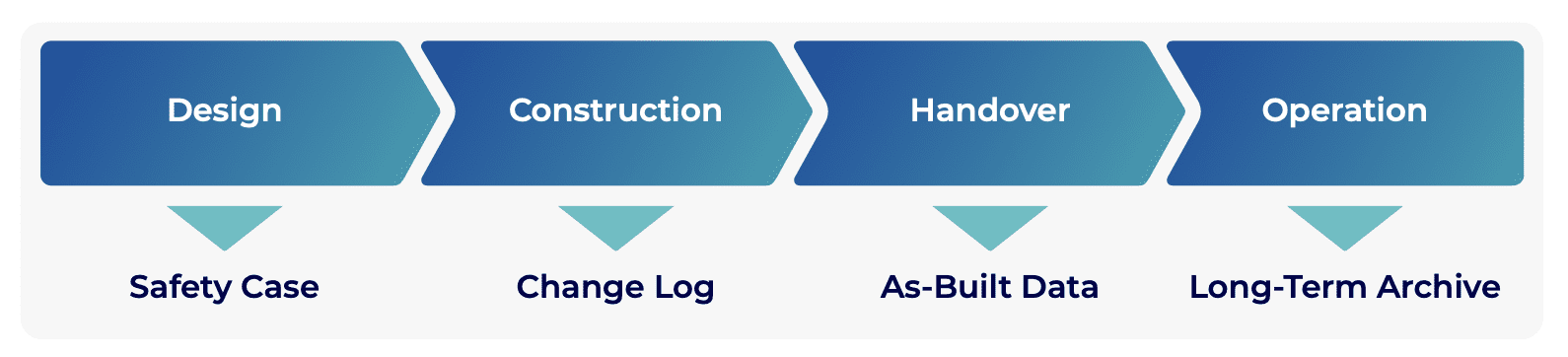
The legislation embeds the concept of a transparent, digital record of decisions, designs, and changes. This golden thread ensures continuity of information across design, construction, and occupation. It underpins accountability and creates a foundation for safer management of assets over their entire lifecycle. Dave Moyes, Partner at Simpson Haugh, highlighted the importance of record-keeping: “Having some form of information management tool is important… it’s about reinforcing what we do and ensuring information is readily available, organised, and retained.” He stressed that “capturing those decisions made by senior staff is going to be critical, particularly now that liabilities extend to 50 years.”
Golden Thread
Implementation Challenges
Regulatory Delays
A major barrier has been the slow processing of Gateway 2 applications. Out of nearly 1,500 submissions since October 2023, only two new high-risk buildings have been approved. This is contributing to stagnation in housing delivery, undermining government ambitions to expand the housing stock. Alan Binns, Director at Project 4, observed, “The Building Safety Act comes off the back of the Grenfell Tower tragedy… it was a moment for reflection for the industry to work out what we can do to make sure it never happens again.” Yet he also acknowledged that approval times are “trending in the wrong direction,” with applications now taking more than 18 weeks.
Lack of Feedback and Clarity
Design teams report insufficient guidance from regulators on acceptable solutions, leading to uncertainty. This lack of clarity is particularly problematic given the gray areas that naturally exist within building regulations, where projects often require nuanced judgments.
Increased Liability
With liability periods extended to 50 years, firms face new risks. Documentation and record-keeping have never been more critical, but many organisations lack robust systems to ensure continuity, especially as staff retire or technologies evolve.
Information Management Gaps
While some firms already excel in information management, others are struggling to implement structured processes. Without investment in digital tools and staff training, the golden thread risks becoming fragmented or incomplete, undermining its purpose. Andy Weston, Director of Account Management at Newforma, warned of the risks of digital obsolescence: “Will we still be able to open a PDF in 20 years’ time? There are going to be headaches.” He added, “The golden thread requires digital strategies that can stand the test of time, ensuring continuity and resilience.”
Opportunities for the Industry
Despite the challenges, the BSA provides a chance for the industry to make long-overdue improvements. The goal should not simply be compliance with the minimum requirements of the Act. Instead, organisations should seek to follow both the letter and the spirit of the law – using its framework to transform safety, collaboration, and design practices. By doing so, firms can move beyond box-ticking exercises and truly improve the culture of construction.
- Embedding Safety by Design: By requiring sign-off at multiple stages, the Act ensures safety considerations cannot be bypassed or diluted. When embraced fully, this mindset encourages design teams to anticipate safety implications from day one, fostering better collaboration between disciplines.
- Client Engagement: For the first time, clients are accountable for providing clear information requirements and supporting safety cases. This encourages stronger collaboration between clients, design teams, and contractors. Clients who embrace this role will not only meet legal obligations but also shape higher-quality outcomes and reduce long-term risks.
- Improved Design Collaboration: Following the spirit of the Act compels all project participants to engage in open communication and transparent record-keeping. This shared responsibility breaks down silos between architects, engineers, and contractors, leading to more integrated and resilient designs.
- Raising Standards of Practice: Firms that adopt rigorous compliance strategies will distinguish themselves in the market, strengthening reputations and reducing future disputes. By embedding safety and accountability into everyday processes, organizations can gain a competitive advantage.
- Expanding Scope: The Act may soon cover other building types, such as hotels and care homes, broadening its influence across the sector. Preparing now for that expansion ensures firms will be ready to deliver safe, compliant projects across diverse asset types.
Ultimately, the opportunity lies not in doing the bare minimum but in using the Act as a catalyst for innovation. Firms that align their practices with it’s intent will not only safeguard lives but also foster trust, improve collaboration, and deliver better, safer buildings.
Actionable Recommendations
- Invest in Robust Information Management Systems
Implement digital platforms that link drawings, compliance records, and correspondence. Regularly update archiving strategies to ensure long-term accessibility, and integrate systems with BIM for seamless data management. - Define Roles and Responsibilities Early
Clarify contractual scopes for duty holders – particularly the Principal Designer – at the outset of projects. Ensure that deliverables are documented and aligned with the golden thread. - Prioritise Gateway Readiness
Develop clear narratives for Gateway submissions rather than relying on bulk document uploads. Structure applications to demonstrate compliance logically and concisely to regulators. - Enhance Training and Competence
Invest in professional development to ensure design and construction staff understand their duties under the BSA. Competence across the supply chain will reduce errors and delays. - Engage Clients in Safety from Day One
Encourage clients to define their long-term information requirements at project inception. This will ensure that as-built data aligns with operational needs and supports future safety cases. - Collaborate with Regulators
Foster dialogue with the Building Safety Regulator to improve clarity and consistency of feedback. Industry bodies should continue to press for streamlined processes that balance rigor with efficiency. - Monitor and Adapt to Scope Expansion
Prepare for the likelihood that additional building types will fall under the BSA. Firms should develop flexible compliance frameworks that can adapt to evolving legislation.
The Role of Newforma in Supporting Compliance
Newforma provides the information management backbone that organisations need to meet BSA requirements. It’s project information management platform directly supports the golden thread by linking all project correspondence, drawings, and compliance documents in one accessible environment.
Centralised Record-Keeping: Newforma ensures that compliance evidence is captured and stored in a structured way.
Traceability: By associating emails, drawings, and documents, Newforma creates a clear audit trail – vital for meeting extended liability requirements.
Collaboration: The platform enables secure sharing across design teams, contractors, and clients, reducing silos and ensuring consistent compliance documentation.
Long-Term Access: With a focus on digital archiving, Newforma helps mitigate concerns about file formats and ensures records remain accessible decades into the future.
In short, Newforma translates the golden thread from a legal obligation into a practical, day-to-day business process.
Conclusion
The Building Safety Act is ushering in a new era of accountability and transparency. Its requirements are challenging traditional ways of working, but they also offer a blueprint for a safer and more resilient construction industry. While delays, uncertainties, and increased liabilities present short-term difficulties, proactive organisations can turn compliance into a competitive advantage.
The way forward is clear: embrace the golden thread, invest in information management, engage clients early, and cultivate competence throughout the supply chain. With solutions like Newforma in place, firms can not only meet the requirements of the BSA but also drive a cultural shift that prioritises safety, trust, and long-term value in the built environment.