
Under the Building Safety Act, it’s no longer enough to show what was built. You have to show why. Newforma’s James Lawrence and James Cooke talk through what that means for design teams working on higher-risk buildings, from tracing a safety decision to closing out a concern properly
Let’s start simple. What do people get wrong about the golden thread?
James Lawrence: Most teams think of it as a document store. Final drawings, final specs, O&M manuals, all in one place. That’s part of it. But the regulator wants more than the end state. It wants to see how you got there. If the fire strategy changed between Stage 3 and Stage 4, you need to show who proposed it, who checked it and what it was based on.
James Cooke: I’d add that the “why” is usually the hardest part to find because it rarely sits in a system of record. It’s hidden in an email exchange between the façade engineer and architect, a note on a marked-up PDF or meeting minutes that were never properly filed. The decision is real, but the reasoning behind it is spread across countless conversations and inboxes.
Why does that matter so much now?
JL: Because the burden of proof has moved. Dutyholders have to show they planned, managed and monitored the work so it complies. Gateway 2 approval depends on it. At Gateway 3, you’re handing over information the Accountable Person will rely on for the life of the building. If you can’t show the context behind a safety decision, it’s very hard to argue it was a sound one.
JC: This isn’t just a hypothetical problem. Teams have seen applications held up because key information was missing, inconsistent or difficult to trace. Often the design work wasn’t the issue. The evidence behind it was.
Take us through an example. What does “retrieving the context” look like in practice?
JC: Say you’re six months into construction and a contractor wants to switch a firestopping product because of lead times. That’s a perfectly normal change, but the obvious question is: what was originally specified, and why? You should be able to trace the full story from the specification clause, through the RFI, the fire engineer’s response, the revised drawing and the transmittal that issued it. All in order. In minutes, not days.
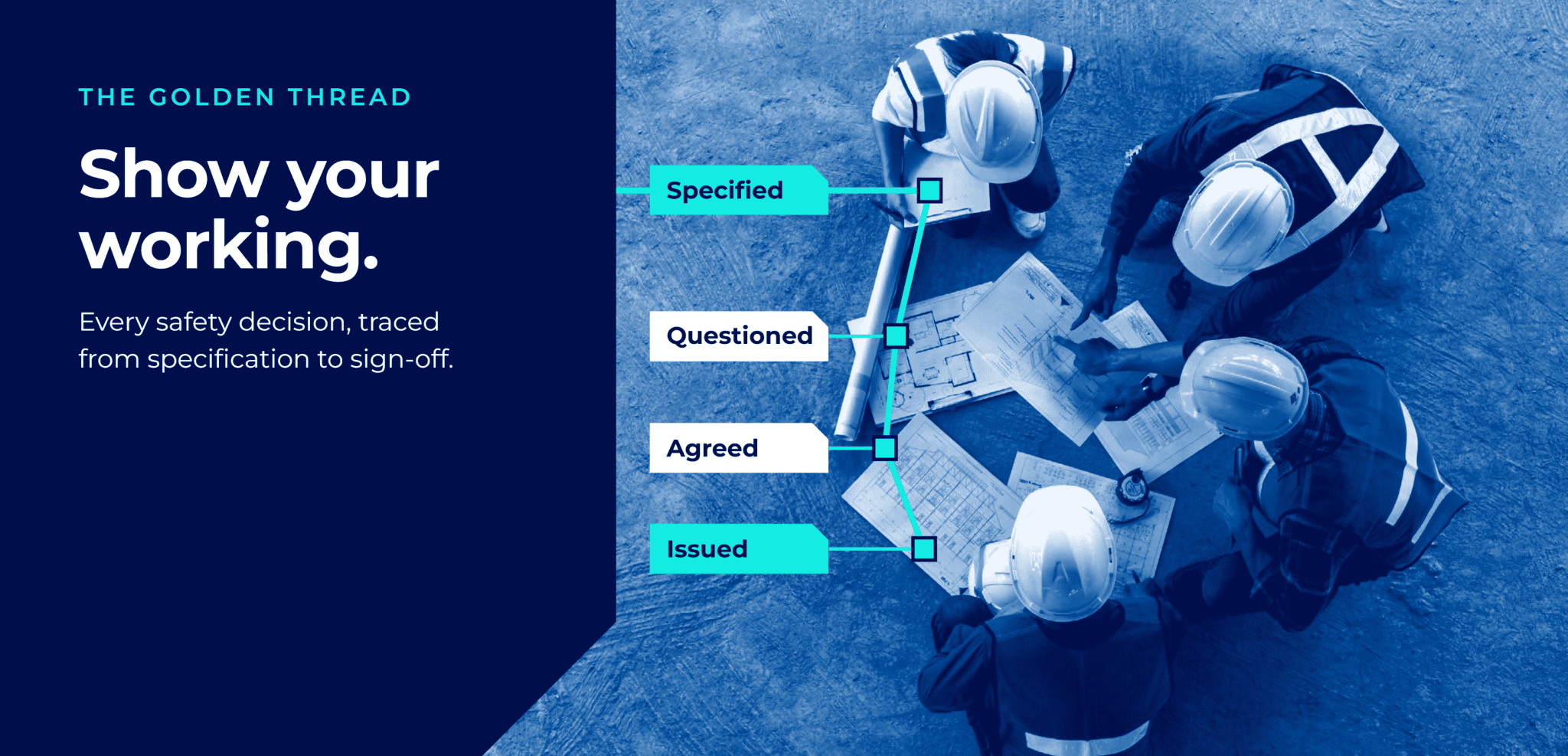
JL: That chain is the Golden Thread in practice: what was specified, questioned, agreed and issued. If one link is missing, you end up rebuilding history from memory. And memory isn’t evidence.
The act puts a lot of weight on named dutyholders. How does accountability play out on a live project?
JL: Every safety concern needs an owner. Not a team, a person. When an M&E engineer flags that a riser penetration doesn’t match the compartmentation drawings, the record should show who raised it, when and who it went to. Then who responded, what they said and how it was closed.
JC: The real challenge is rarely raising an issue. Most teams do that well. It’s closing the loop that causes problems. A concern gets discussed in a site meeting, a decision is made, and everyone gets on with the job. The trouble starts later when someone asks how that issue was resolved and there’s no clear record of the answer.
So what does “closed properly” look like?
JC: For me, something isn’t closed just because someone says it is. I want a response from the right person, evidence that the issue was addressed and a sign-off that links back to the original concern. That evidence might be a revised drawing, a site photo or an inspection record. If you can follow the trail from start to finish without having to call anyone, it’s closed.
JL: It also protects people. Architects and engineers are understandably worried about liability under the new regime. A clean record of how you handled a concern is your best defence. If you raised it, chased it and got it resolved, you want that on file with your name on it.
“That chain is the Golden Thread in practice: what was specified, questioned, agreed and issued. If one link is missing, you end up rebuilding history from memory. And memory isn’t evidence.”
Where does mandatory occurrence reporting fit in?
JL: On higher-risk buildings, principal designers and principal contractors need a system for reporting certain safety occurrences to the regulator. That’s a formal step with its own rules. But it relies on the same habits. If you’re tracking issues properly day to day, you’ll spot the ones that need reporting much sooner. And you’ll have the history ready when you do.
A lot of firms still run projects on email and shared drives. Is that enough?
JC: That approach can work on a smaller project. On a higher-risk building, with dozens of consultants and thousands of emails, it becomes difficult very quickly. The challenge isn’t storing the information. It’s connecting it. An email about a cavity barrier should sit alongside the RFI, the drawing and the response, not disappear into someone’s inbox.
JL: That’s where I see firms getting real value from tools that capture project email and documents in one place and tie them to the item they’re about, like an RFI, a submittal or an action item. You don’t have to change how people work. You just stop losing the record of it.
If a firm wants to start now, where should it begin?
JC: There’s a simple way to find out how good your records really are. Pick a live project, choose a safety-critical decision and try to reconstruct the trail behind it. Time yourself. If it takes hours to find the answer, or you need to call three different people, you’ve learned something important.
JL: Then fix the basics. Agree how issues get raised and who owns them. Make sure responses are recorded where the whole team can see them, not buried in private email. And file each decision against the thing it relates to. None of that needs a big change programme. It needs consistency.
What’s the one thing you’d want readers to take away?
JL: The regulator isn’t asking for paperwork for its own sake. It’s asking you to show your working. Most teams already do the thinking. They just don’t keep the trail.
JC: Treat every safety conversation as if someone will ask about it in 10 years’ time. On a higher-risk building, someone probably will.
*Please note, this is a commercial profile.