

While awareness continues to grow of the importance of cavity barriers in protecting from the rapid spread of fire through building cavities, it is important to remember that passive fire protection is also essential in non-combustible cavity walls for multi-occupancy buildings
Cavity barriers are very much associated with controlling the risk of the spread of fire in a rainscreen façade. However, it is just as important that passive fire protection is a key safety factor in a traditional masonry application.
Liam Blears, head of façades at passive fire protection specialist FSi Promat, discusses the protection requirements for more traditional brickwork projects and how to ensure best practice.
Recent years have seen an increase in Modern Methods of Construction and a move towards alternative façade finishes, yet brickwork projects continue to dominate the UK construction market accounting for 70% of the market across all sectors.
From a planning point of view, a brick application can even be essential depending on the location, such as in parts of Manchester or London where there is a preservation order in place.
While this has seen an increase in the use of brick slips for projects, there remains a huge interest in traditional brickwork, with a number of contractors continuing to specialise in this across buildings of all sizes.
It’s not unusual to see brickwork finishes on student accommodation blocks, for example, and, as with all multiple occupancy buildings, it is essential that the correct level of passive fire protection is specified and installed in line with Part B of the Building Regulations, which stipulate that cavity barriers must be used at all compartment lines and around all openings in non-standard dwellings. Or, where there is one or more apartments in a block, they must also be used at all compartment lines and around all openings in a non-standard dwelling.
Controlling the rapid spread of fire
While masonry is essentially non-combustible, it is still vital to protect that from the threat of fire. The same requirements still apply in masonry facades as they do in ventilated facades, in terms of this being a concealed cavity, and as such must have the correct provision of compartmentation to prevent the uncontrolled spread of fire. This makes it essential to use cavity barriers to provide this compartmentation in line with the fire performance requirements for the specific project.
To this end, cavity barriers should be installed where there is a need for compartmentation, with cavity barriers placed at floors, walls and around all openings to provide a compartment to prevent the spread fire within that cavity wall for a set period of time. This allows a safe means of escape for occupants and also time for firefighters to evacuate the building and extinguish the fire.
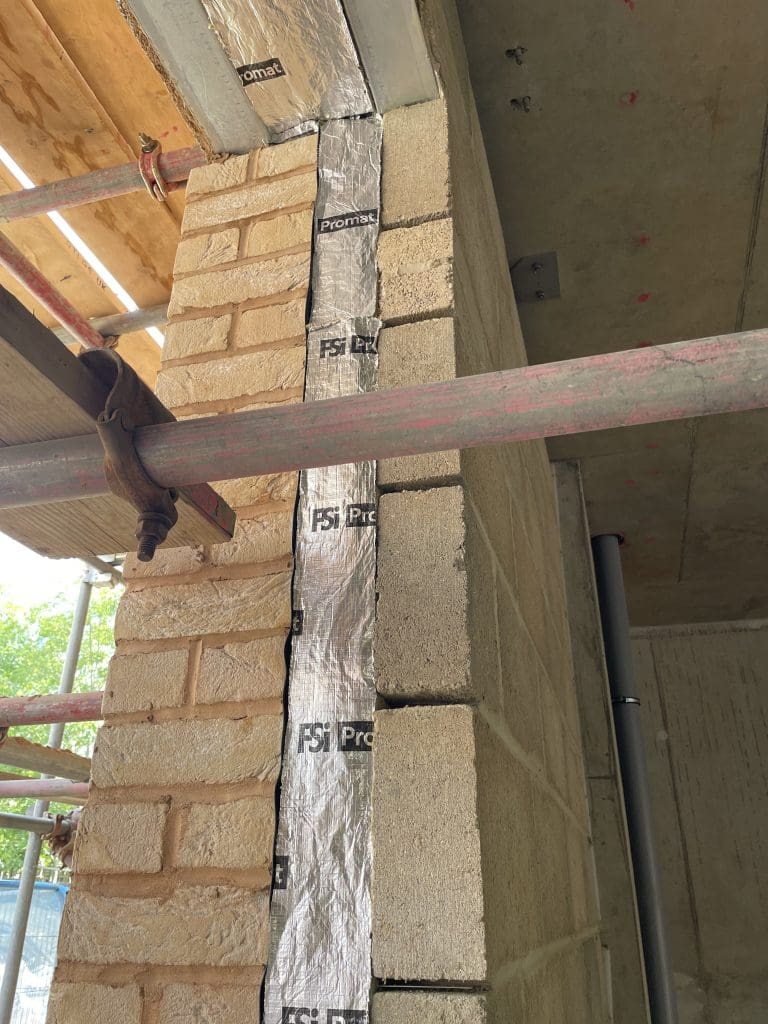
While there is a perceived lower risk in a masonry façade, this does not mean there should be a reduced focus on the correct cavity barrier specification. It is important that cavity barriers are fully tested, meet the project requirements, and are third party certified.
To ensure a tested level of passive fire protection in line with the Building Safety Act, a fully tested and compliant solution should always be used. A correctly specified and installed cavity barrier will ensure that compartmentation remains intact and, in the event of a fire, works to prevent the spread of fire between compartments within the cavity wall.
Getting it right first time
A key consideration in the use of cavity barriers in a brickwork setting is installation. The importance of installation to the effective performance of passive fire protection can never be underestimated and, with this in mind, it is essential that installation is carried out in line with the testing, as there is an even greater emphasis on getting it right first time in a masonry application.
Due to the nature of a brickwork build, mistakes are incredibly costly and difficult to rectify. This puts an onus on quality assurance from the very first stage of a project. Once a cavity barrier has been installed, it is vital that early checks are carried out to ensure that installation is accurate and in line with the tested solution to ensure it will provide the level of protection needed when the building is complete.
FSi Promat cavity barriers are dry fitted and easy to install, plus, it is easy to see visually that it has been correctly installed. This, in turn, supports straightforward quality assurance that is easy to carry out to ensure the compliant installation and use of cavity barriers to support the overall passive fire protection solution for a building.
It is also important to consider any interfacing issues that may arise as a result of the build, and whether additional testing may be required. For example, where a masonry wall meets a steel framing solution, this may require a particular application of cavity barrier to ensure compliant passive fire protection. Where multiple substrates need protection on an interface this should be tested and a compliant solution used.
Best practice
While modern facade construction remains in the spotlight, it is vital to remember that even when products that are essentially perceived as non-combustible are used, the required level of passive fire protection must still be built in to protect future occupants.
Where a cavity wall exists, there remains the risk of uncontrolled fire spreading throughout a building. As the industry continues to focus on improving safety, it is essential that best practice is always used where passive fire protection systems are required.
*Please note that this is a commercial profile.