
As Britons endure another scorching summer with bouts of record warmth up and down the country, it bears repeating that this state of affairs is fast becoming the new normal – a new normal with increasing infrastructural and policy implications
This is especially the case when it concerns access to fresh water. And by extension, the pressing need to construct new reservoirs to better maximise the supply we do have while stockpiling for the lack of rainy days.
Or, in the age of climate change, downpour days so intense, it leaves little ability for soil to absorb said moisture, requiring large artificial or man-manipulated catch basins.
The conversation surrounding the need to do more gained added traction back in the spring when it was widely reported that the country experienced one of its driest three-month periods on record.
Sun worshippers may have basked in the Mediterranean-like air and strawberries may have turned an uncharacteristic ruby-red but images out of the Woodhead Reservoir in Derbyshire were also turning heads.
With water levels at record lows, water minister Emma Hardy warned the UK could face shortages of drinking water within a decade.
Fast-tracking the proposed Fens Reservoir in Cambridgeshire and the Lincolnshire Reservoir still places estimated project completion dates out to 2036 and 2040, respectively.
With the clock ticking, can more be done to cut costs, drive workflow efficiencies, maintain speed and build accuracy, and accelerate these timetables before our taps run dry?
3D laser scanning: A ‘flood’ of unmatched potential
The answer to the above question is ‘yes’.
Although the technology has been around in various forms for several decades, ongoing advances in speed, accuracy, automation, portability and ease-of-use mean that today’s generation of laser scanning solutions bears little resemblance to the products of yesteryear.
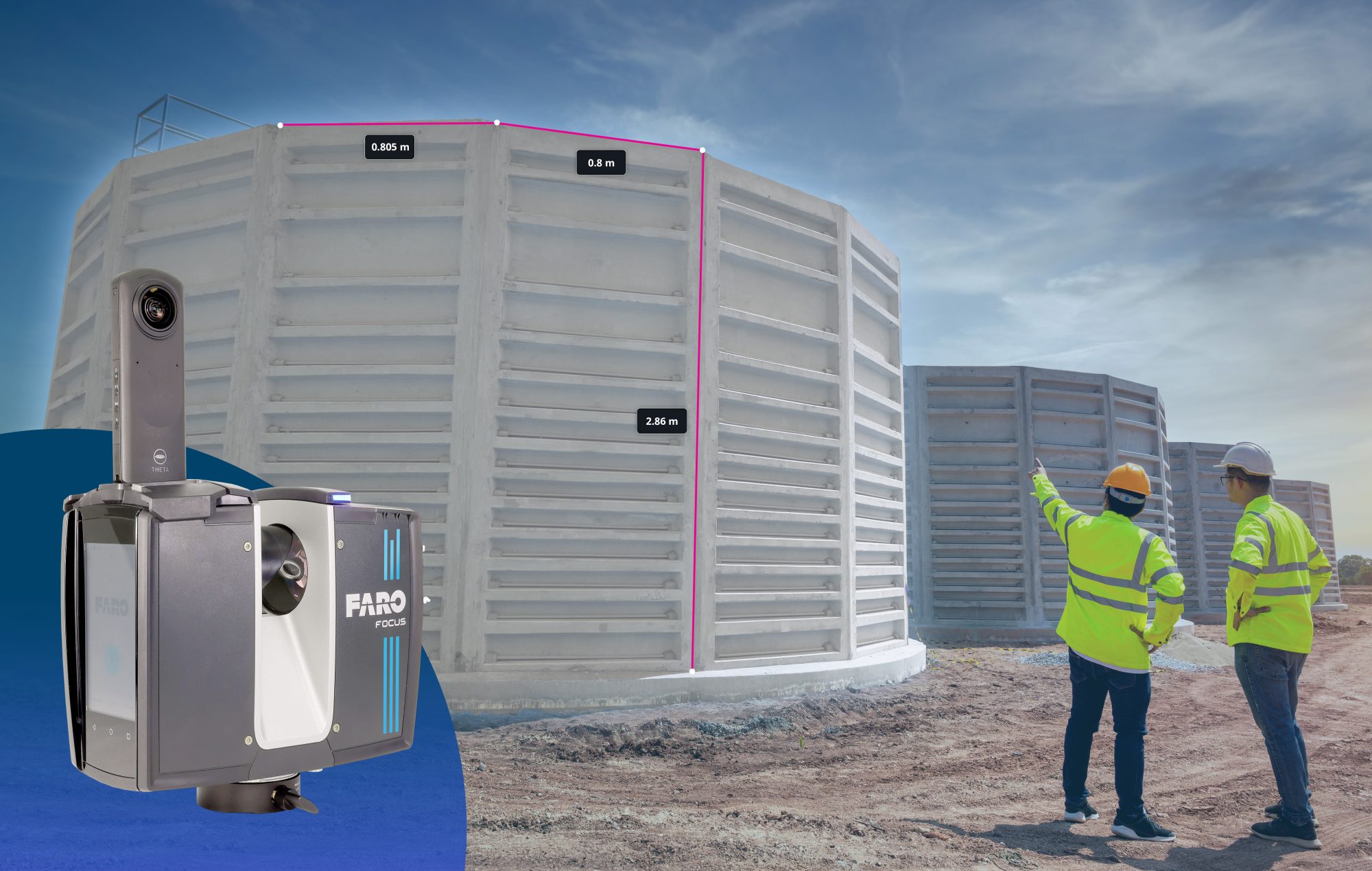
Modern laser scanners, like the FARO® Focus Laser Scanning Solution, for instance, boast faster time to data through the power of Flash scanning, a proprietary software algorithm that enables users to halve the time it takes to capture 3D point clouds.
Meanwhile, an impressive scanning range – up to 400m – leads to superior area coverage per scan position and is ideal for geospatial applications like topographical surveying or infrastructure projects – both critical elements when either building a new reservoir from scratch or expanding/retrofitting an existing one.
With superior scan-to-BIM workflows, tripod-based terrestrial laser scanners like the Focus help ensure the construction process goes smoothly, requiring fewer on-site personnel and greater confidence the final structure (in this case, two reservoirs) aligns with the design intent, reducing the risk of downstream errors, saving both time and money.
Moreover, the scan data is vital for project supervision and collaboration across different trades, as well as sharing that information via cloud-based platforms, like the FARO Sphere XG® Digital Reality Platform, with additional priority stakeholders.
Of course, terrestrial laser scanners are just the beginning in the contemporary reality capture arsenal. Smaller, lighter and even more versatile, the FARO® Orbis™ Premium Mobile Laser Scanner combines fast mobile scanning data acquisition with detailed static scans using Flash Technology™.
These scanners thrive in the geospatial industry, especially in surveying and mapping through workflows like infrastructure surveying or corridor mapping, making them the ideal choice for tasks that demand flexibility and precision.
As it relates to reservoir construction, the technologies can assist with a variety of tasks, including, but not limited to, site assessment and feasibility, design planning, construction monitoring, post-construction maintenance/ensuring lifecycle longevity and documentation and compliance.
Likewise, the new FARO® Blink™ Imaging Laser Scanner can perform many ancillary tasks related to reservoir construction.
Designed as the ideal tool for simplicity of use, Blink takes 360-degree images and builds a corresponding point cloud “underneath” a compelling visual. This makes it particularly effective at documenting site progress, mapping pipe rooms, pumping stations and other indoor facilities.
Digging deep: How else can 3D laser scanning assist?
But what specific roles can 3D laser scanning of reservoirs help accelerate?
For site assessment, devices like the Focus and Orbis can perform topographic mapping – high-resolution 3D scans to create detailed terrain models – capturing natural contours, slopes and geological features.
There are also volumetric calculations to consider, critical in designing/planning embankments or spillways. Even vegetation and obstruction mapping can all be rendered in virtual 3D models, added to a BIM model.
From a design and planning perspective, scanned data can support hydrological models to simulate reservoir fill rates, flood scenarios and spillway performance.
Last, and perhaps most obvious, 3D laser scanning ensures precise placement of intake structures, tunnels and access roads by integrating laser scan data with geospatial design tools. This is beneficial not only during initial construction but also as part of continual upkeep, identifying structural shifts over time with repeat scans, and crack detection and erosion damage.
Putting it all together
Thus, as the UK moves deeper into August and an autumnal chill inevitably settles in, here’s hoping the powers that be consider the latest 3D laser scanning solutions to expedite the Fens Reservoir and Lincolnshire Reservoir projects.
And, for future projects not yet shovel-ready in our increasingly climate changing world.
Please note: this is a commercial profile