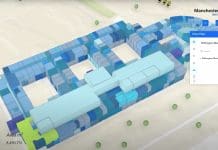

A university research project has developed a comprehensive, design-stage methodology for accurately identifying and prioritising carbon emission reduction strategies across the entire building life cycle by integrating BIM with life cycle assessment
The study by Yujing Yang’s team at Shanxi University, published in Energy & Environment Nexus, used an integrated Carbon Emission Estimation for Buildings (CEEB) framework based on BIM and life cycle assessment principles to first quantify carbon emissions across material production and transportation, construction operation, alternative heating scenarios and the full building lifecycle by applying standardised calculation equations and scenario-based sensitivity analyses.
Using an office building in northern China as a case study, the results show that operational emissions – especially from heating – dominated total emissions, highlighting how early design and technology choices can substantially reduce a building’s long-term carbon footprint.
Buildings worldwide account for about one-third of total energy use and carbon dioxide emissions, driven mainly by heating, cooling and material production. In China, construction-related emissions have more than doubled since the mid-2000s, placing the sector at the centre of national decarbonisation efforts.
Across a building’s lifecycle, emissions stem from material production and transport, construction, operation and maintenance, and demolition.
However, comprehensively quantifying emissions across all stages and linking them to design decisions remains challenging. BIM addresses this gap by integrating geometric, material and operational data, enabling carbon assessment to be embedded directly into the building design process.
Measuring emissions
The results show that during material production, steel was the dominant carbon source, emitting 270.87 tCO₂ eq and accounting for 46% of production-related emissions, followed by concrete (29%) and cement (21%), indicating that emission reduction in material manufacturing should prioritise steel and cement-intensive processes.
In contrast, transportation emissions were disproportionately driven by sand, which contributed 40% of transport-related emissions despite its negligible production footprint, highlighting logistics as a critical mitigation leverage point.
Sensitivity analysis further demonstrated that shortening transport distances and switching to lower-emission vehicles could reduce total material transport emissions by up to 73.9%. For the operational phase, BIM-based energy simulations revealed that coal-based heating dominated emissions, with bituminous coal alone accounting for nearly 45% of operational emissions and heating-related activities responsible for almost two-thirds of total operational carbon output.
Comparative scenario analysis showed that replacing coal-fired heating with ground-source heat pumps could cut heating emissions by over 50% and reduce total lifecycle emissions by nearly 19%, outperforming natural gas and air-source heat pump alternatives in cold regions.
Finally, lifecycle integration confirmed that operation and maintenance overwhelmingly dominated total emissions (94.62%), while material production and transportation contributed about 9%, and construction and demolition were negligible.
Carbon mitigation efforts should focus on operational energy
Together, these results demonstrate that carbon mitigation in buildings should prioritise operational energy systems, low-carbon heating technologies, material efficiency and localised supply chains to achieve meaningful lifecycle emission reductions.
The findings underscore that meaningful emission reductions in buildings depend far more on operational energy systems than on construction activities alone. By integrating carbon estimation into BIM at the design stage, architects and engineers can compare materials, heating technologies and supply chains before construction begins. This enables targeted strategies such as adopting renewable-based heating, improving building envelope insulation, using low-carbon materials and sourcing materials locally to minimise transport emissions.