
As steel detailers face tighter schedules, increasingly complex hybrid structures, and ongoing labour shortages, automation and interoperability are no longer optional – they are essential to staying competitive
ALLPLAN’s latest release of SDS2 2026 reflects this shift. By enhancing automation, expanding material versatility, and strengthening integration with cloud-based platforms such as BIMPLUS, the new version aims to transform how engineers and fabricators approach steel detailing – turning repetitive manual processes into intelligent, connected workflows.
Tackling the productivity challenge in steel detailing
Across many engineering offices, time is still lost to the repetitive, manual tasks that underpin every detailing project. Compiling connection reports, maintaining revision consistency across hundreds of sheets, and managing multiple file versions are all labour-intensive processes that can delay delivery and increase the risk of errors.
At the same time, the growing use of hybrid materials – combining steel with aluminium, stainless steel, or FRP – adds design complexity and further strains already stretched teams. The challenge is no longer just about modelling accuracy; it’s about managing data efficiently and ensuring every stakeholder works from the same, verified information.
SDS2 2026 answers these challenges by focusing on efficiency where it matters most: in the automation of connection design, drawing control, and data coordination across teams and platforms.
Smarter detailing through automation
Automation isn’t about replacing detailers. Instead, it’s about giving them the tools to focus on buildability, coordination, and the decisions that matter most. SDS2 2026 introduces several intelligent workflows designed to reclaim valuable time for engineers and fabricators.
For example, the new connection grouping feature automatically consolidates similar connections, identifying the “controlling” example in each group and generating a concise, code-compliant package for review. Instead of manually compiling hundreds of near-identical reports, detailers can now produce submittal documentation in minutes while maintaining accuracy and traceability.
Similarly, the new batch-editing functionality for revision charts significantly speeds up detailers’ drawing workflows, allowing teams to visualise and edit information across multiple sheets at once. This improvement, while seemingly modest, addresses one of the most time-consuming administrative tasks in detailing – ensuring consistent updates across large drawing sets without the risk of missing a revision.
Bridging design and fabrication
Automation doesn’t stop at the modelling stage. With the 2026 release, SDS2 strengthens the bridge between design and fabrication through enhanced data exchange and cloud integration.
New welding improvements enrich the data contained within IFC exports and BIMPLUS uploads, ensuring every weld point – including robotic layout nodes – is accurately communicated to fabrication teams. By providing complete weld information directly in the model, fabricators can take full advantage of robotic assemblers and welders, significantly reducing setup time and potential errors.
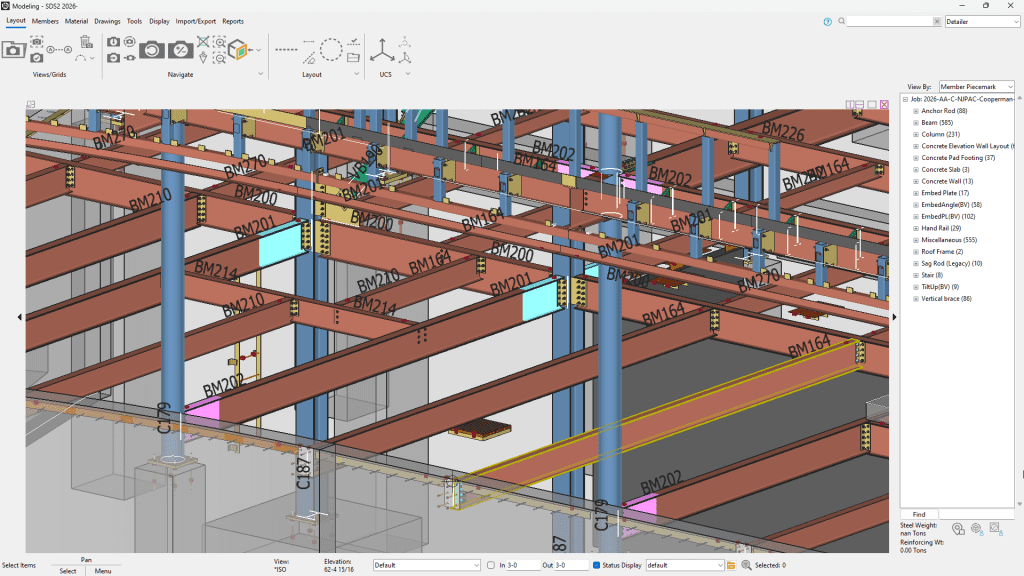
Meanwhile, the integration with BIMPLUS, ALLPLAN’s open cloud collaboration platform, continues to evolve. Detailers can now upload SDS2 models directly to BIMPLUS for clash detection, issue tracking, and model based coordination. Drawings, CNC data, and BOM details can be attached directly to 3D objects, ensuring a single, traceable source of truth across all stakeholders. This interconnected workflow eliminates silos and enhances visibility across the entire project lifecycle – from detailing to fabrication to construction.
Building confidence and quality
SDS2 has long been known for its intelligent connection design, which builds fully validated connections based on the complete framing condition, load requirements, and fabrication preferences. The 2026 release expands support for more complex and custom connections, with intelligent checks for buildability, such as compliant slot and bolt combinations, or automated weld and hole validation.
Designers and detailers can count on every connection aligning with industry standards and fabrication needs, which means faster verification, fewer manual corrections, and greater trust in the detailing output.
At the same time, to support the need for increasing accountability and transparency across digital workflows, SDS2 has also introduced verification problems for North America and Europe – standardised test cases that validate the accuracy of connection design results against recognised benchmarks.
These examples allow engineers to verify performance with confidence, knowing the software has been rigorously tested for accuracy and compliance.
Together, these advances reflect how ALLPLAN is turning automation, accountability, and verified performance into a foundation for smarter, more trustworthy steel detailing – helping teams deliver complex projects faster, with greater confidence, and ready for an increasingly automated fabrication future.
Book your SDS2 demo here.
*Please note that this is a commercial profile.