
Advances in cloud-based artificial intelligence are introducing new approaches to scaffolding safety inspection and compliance within construction site management
In construction, few structures are as ubiquitous – and as potentially hazardous – as scaffolding. Despite decades of regulation and improved training, scaffolding-related accidents remain one of the leading causes of workplace injuries and fatalities. The problem is not the technology of scaffolding itself but the way it’s monitored.
Most inspections are still carried out manually through visual checks, relying heavily on human judgement and experience. On large or complex sites, this can be inconsistent, time-consuming and prone to error.
Now, a new research-led solution from Luleå University of Technology in Sweden promises to change that dynamic. The study, Safety Assessment of Scaffolding on Construction Site Using AI, proposes a cloud-based artificial intelligence (AI) system that automates scaffolding inspections using LiDAR scanning and digital twin technology, delivering faster, safer, and more accurate safety assessments.
From manual checks to digital intelligence
According to the research team – Sameer Prabhu, Amit Patwardhan and Ramin Karim–traditional visual inspections are inherently limited. As construction progresses, scaffolding is often modified to accommodate access needs or shifting site conditions. Missing braces, non-compliant alterations, or structural deformations can easily go unnoticed until it’s too late.
Their proposed AI-powered inspection platform transforms this process into a proactive, data-driven safety system. By integrating LiDAR point cloud data, cloud computing, and graph-based analysis, the system continuously monitors scaffolding against its certified design model.
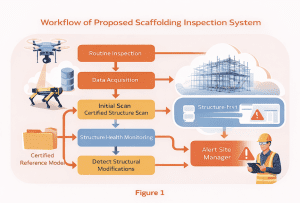
As shown in Figure 1, the workflow begins with an initial certified scan when the scaffolding is first erected. This digital model becomes the benchmark, or “reference twin,” against which all subsequent scans are compared. Periodic site scans – captured via drones, stationary sensors, or even robotic dogs – are uploaded to the cloud, where the AI automatically detects any deviations or missing elements.
If a potential safety concern is identified, an alert is instantly sent to the site manager’s dashboard.
Inside the cloud: Where AI meets construction
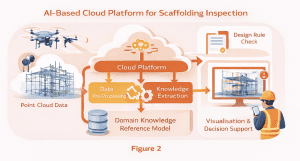
At the heart of the system is a cloud-based analytics platform that processes and interprets 3D point cloud data from the site. As detailed in Figure 2, the platform’s architecture is divided into three core stages:
- Data pre-processing – Filtering, cleaning and aligning raw LiDAR data to isolate the scaffolding structure.
- Knowledge extraction – Comparing the new scan with the reference model to identify any missing or shifted elements.
- Visualisation and decision support – Converting the findings into intuitive visuals, reports and AR overlays for site teams.
The platform’s data pipeline is built on a microservices-based architecture, ensuring scalability and secure data handling. It integrates with existing construction management systems or BIM models, enabling a seamless workflow for large-scale projects.
Importantly, this approach aligns with the Prognostics and Health Management (PHM) framework – a methodology widely used in aerospace and manufacturing to predict asset failures before they occur. Applied to construction, PHM enables continuous monitoring and predictive safety assurance for temporary structures.
Real-time safety in augmented reality
One of the most striking features of this new system is its ability to integrate Augmented Reality (AR) directly into the inspection process. Site managers can use AR glasses or tablet devices to visualise detected anomalies overlaid on the real scaffold structure.
As illustrated in Figure 3, the system highlights missing or deviated braces in real time–orange markers denote structural deviations, while red warnings identify missing components. This allows for immediate on-site verification and targeted corrective action.
This immersive visualisation not only enhances situational awareness but also removes ambiguity from traditional 2D reports. Managers can “see” exactly where an issue lies, bridging the gap between data analytics and physical site operations.

A safer, smarter approach to site management
The adoption of AI-powered inspection tools marks a fundamental shift in how construction safety is managed. Rather than reacting to accidents or failures, site teams can now predict and prevent them.
Some of the key benefits include:
- Enhanced safety compliance: Continuous monitoring ensures scaffoldings remain within design tolerances at all times.
- Reduced downtime: Automatic detection allows quicker interventions, avoiding prolonged project disruptions.
- Lower inspection costs: Automated scans replace repetitive manual checks, freeing staff for higher-value tasks.
- Data traceability: Every modification is logged, providing a digital audit trail for compliance and insurance purposes.
- Improved training: AI-generated models and AR visualisations can serve as interactive safety training tools.
As the research highlights, these advantages can significantly reduce the risk of human error while improving efficiency across large construction projects.
Future potential: towards autonomous safety systems
The Swedish team sees this development as only the beginning. Future enhancements may include automated design rule checking, where the AI system verifies scaffold integrity against national safety codes such as the UK’s Work at Height Regulations 2005 or Sweden’s AFS 2013:4 Provisions.
Integration with Building Information Modelling (BIM) and Internet of Things (IoT) sensors could also enable fully autonomous safety management systems – capable of real-time performance analysis and predictive maintenance scheduling.
“AI in construction safety should not replace site managers,” notes lead author Sameer Prabhu, “but rather empower them with the data and tools to make faster, more informed decisions.”
Aligning with digital construction goals
The UK’s construction industry is already moving towards a digital-first approach through initiatives such as the Construction Leadership Council’s (CLC) Roadmap to 2030 and the Digital Construction Charter.
Technologies like the Luleå AI platform complement these goals perfectly. They align with the government’s Golden Thread of Information principle – ensuring that critical safety and design data remains accessible, verifiable, and continuously updated throughout a building’s lifecycle.
In essence, the integration of AI-based inspection systems represents a step forward in the journey towards zero-accident construction sites.
A digital twin for every scaffold
This research illustrates the power of combining digital twins, LiDAR scanning, and AI analytics to make construction sites safer and smarter.
By transforming the way scaffolding is monitored – shifting from manual, subjective inspection to continuous digital evaluation – construction firms can expect measurable improvements in safety, accountability and cost-efficiency.
As digitalisation continues to reshape the industry, it’s likely that every scaffold, hoist, or crane on a site will soon have a digital counterpart, continuously monitored by AI. The result is not only a safer construction site but also a more transparent and resilient built environment.