
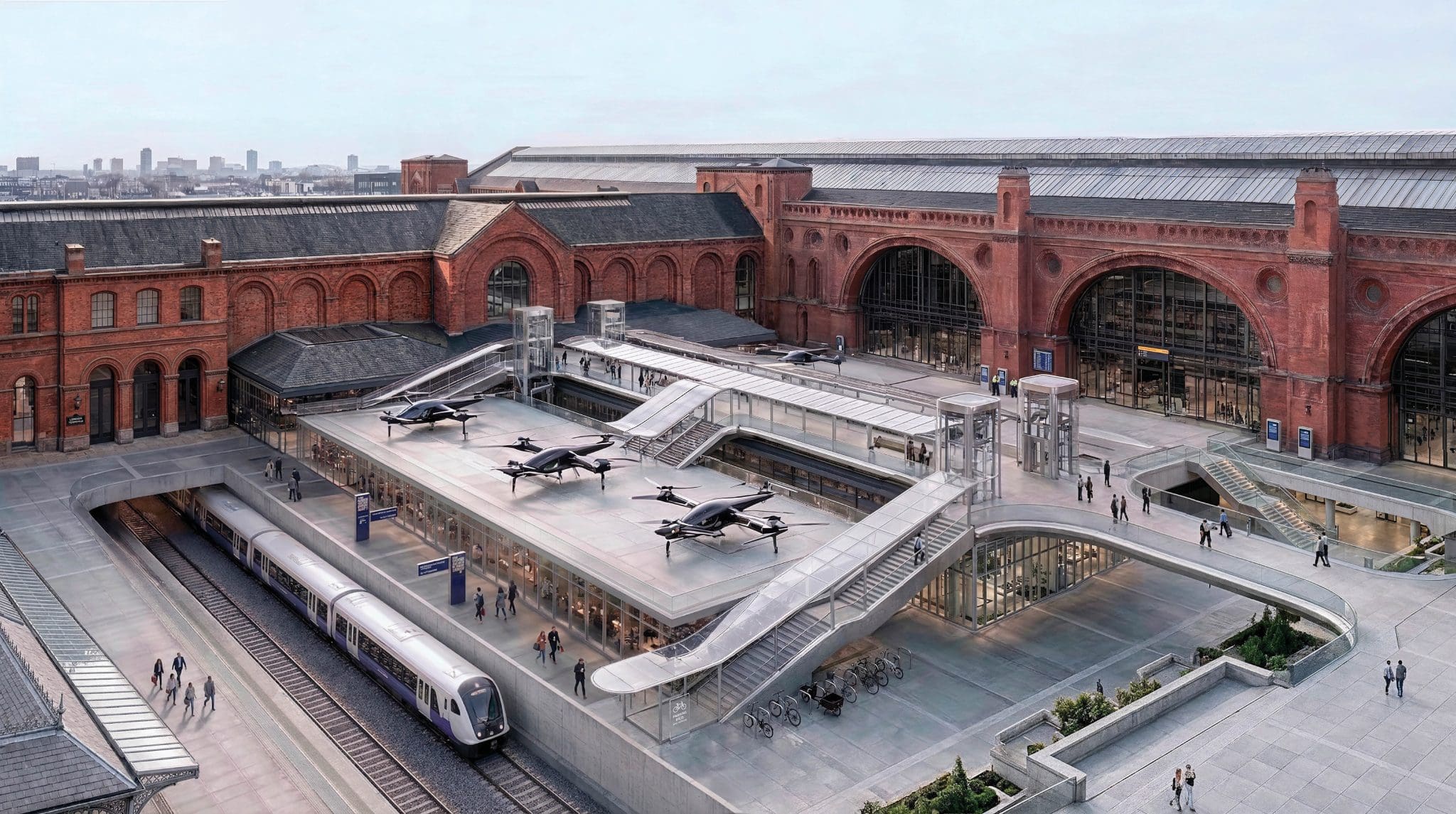
With the use of drones increasing across the built environment, Dr Anna Jackman and Dr Paul Cureton discuss new guidance published by the Royal Town Planning Institute that urges planners to proactively consider how they can shape a successful and socially beneficial future for the technology
Abuzz with aerial drones, UK skies are changing. In new practice advice notes published by the Royal Town Planning Institute (RTPI), we urge that both the growing use of – and ambitions to scale – drones requires prompt and proactive consideration from planners to ensure that the technologies and infrastructures underpinning them be integrated in careful and considered ways.
Drone applications in planning
From infrastructure inspection and asset surveying to development management, enforcement and building control, the first practice advice note, Planning and Drones
1: Using Drones to Deliver Planning Services, outlines the diversity of applications for which drones are being adopted and engaged in planning roles and contexts.
As wider research into local authority drone use in England highlights, drones have proved valuable tools in the assessment and monitoring of assets and infrastructure
including roads, bridges, culverts, buildings and lighting – for and beyond building control.
So too are drones – and the unique perspective of sites they provide – proving useful in the assessment of planning applications and enforcement breaches, which can otherwise be time-consuming, costly, inaccessible and/or unsafe.
Alongside reducing safety risks accompanying workers at height, drones are routinely celebrated as devices at once supporting the gathering of a diversity of data and enabling comparatively rapid real-time and post operation analysis.
Planning for scaled drone use
Our second advice note, Planning and Drones 2: Planning for Scaled Drone Use and Infrastructure, turns instead to external commercial and civil applications.
While skies animated by delivery drone flights and aerial corridors may once have sounded futuristic or sci-fi, from e-retail giant Amazon’s Prime Air delivery drone trials
in Darlington, Couty Durham, to Manna’s trials across the Republic of Ireland, drones – and the launch and landing pads, masts and/or hubs supporting their functioning – are currently confronting planners with live and timely questions.
As drones and their supporting infrastructures animate skies and the built environment alike, there remain a range of challenges requiring further attention and proactive consideration.
While policy and regulatory initiatives to scale drone use in the UK continue apace, research underscores the importance of understanding and learning from public perception of future flight technologies including drones.
Therein, members of the public express concerns about scaled drone use ushering invasions of privacy and risking potential intrusion into private and domestic lives.
Following that the drone’s unconventional noise signature can be understood as particularly annoying to human ears – public concerns also surround the risk of drones adding to or extending visual and aural disruption at ground level into the air above us, while the Civil Aviation Authority (the UK’s aerospace regulator) acknowledges that drones present new challenges for noise legislation.
Our practice advice notes thus stress the critical importance of careful public consultation, engagement and collaboration in order to hear and address concerns meaningfully.
As the RTPI’s Daniel Slade succinctly stated: “If communities feel decisions are happening to them, rather than being made with them, the backlash could result in widely beneficial development not going ahead at all.”
Environmental impacts
The impacts of drones are also not solely limited to humans. While drones are being employed for wide-ranging environmentally beneficial applications, they also
raise challenges in this area too.
Just as members of the public raise questions of if and how such technologies will function harmoniously with wildlife and bird habitats, research highlights the potential for drones to disrupt wildlife and animals in ways requiring further, systematic, evaluation.
Capacity challenges
Challenges also remain with regard to planning resource and capacity, in a sector under strain. As a Future Flight Challenge planning guidance paper outlined, further guidance is urgently needed to support the effective, considered and consistent implementation of
drone projects, as and where they are judged as appropriate.
As drones and the ground-based infrastructures supporting their scaled use increasingly animate boundaries between air and land, planners remain uniquely placed to at once imagine and forge built environment futures mobilising drones as and where beneficial.
To this end, both the practice advice notes, and the provocative visualisations of potential drone futures developed by architectural firm ON-A therein, urge planners, policymakers and communities alike to proactively consider not only the growth in drone activity but what a successful, societally and socially beneficial drone future might and could look like.