

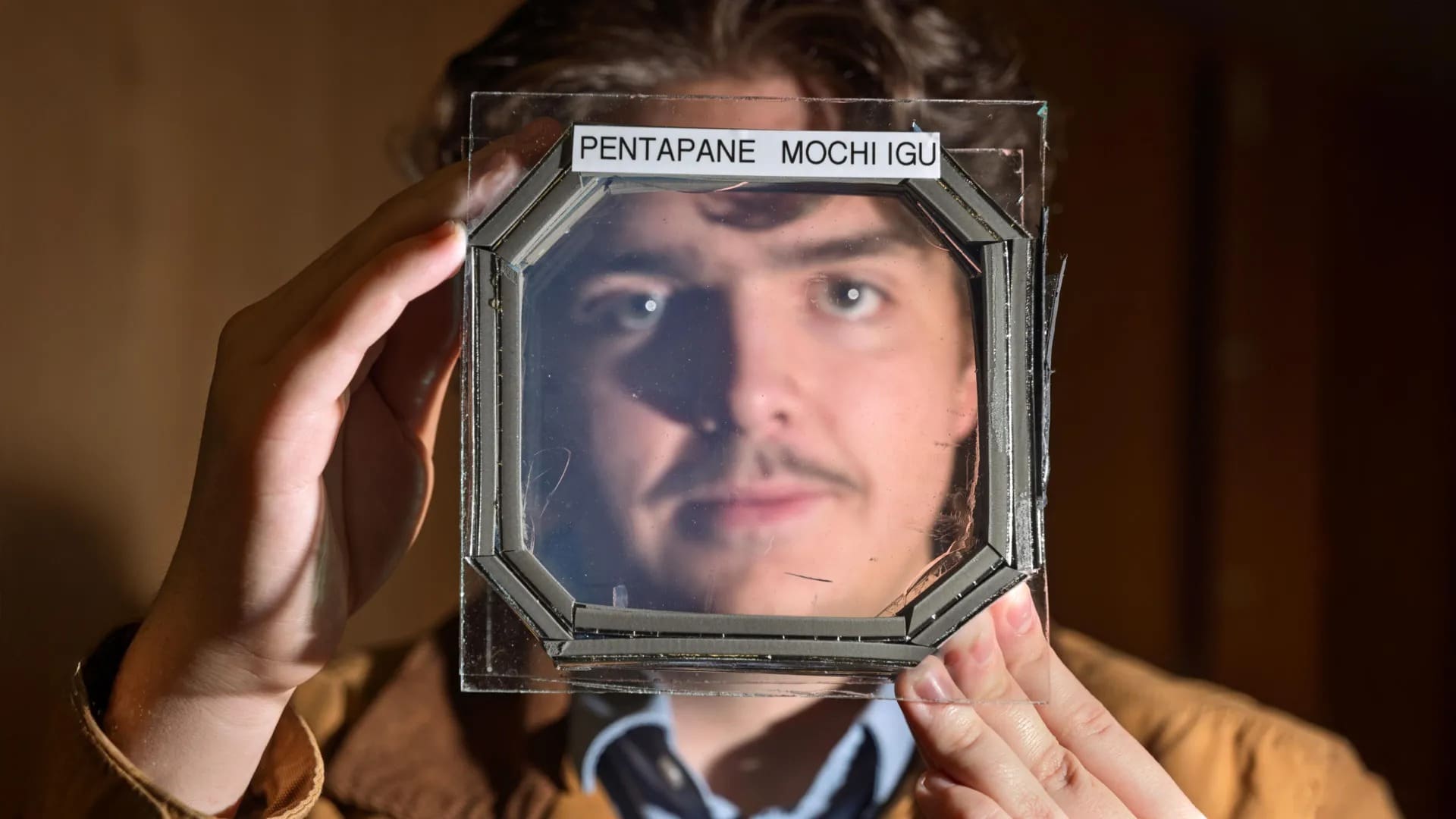
Physicists at the University of Colorado Boulder have created a clear insulation material called Mesoporous Optically Clear Heat Insulator, or MOCHI
The clear window insulation material can be manufactured in thin flexible sheets or thicker blocks and functions similarly to bubble-wrap. When attached to the interior surface of windows, it offers efficient insulation, as well as being transparent.
Buildings account for around 40% of global energy consumption and often face significant heating inefficiencies around windows.
“To block heat exchange, you can put a lot of insulation in your walls, but windows need to be transparent,” said Ivan Smalyukh, senior author of the study and a professor of physics at CU Boulder. “Finding insulators that are transparent is really challenging.”
The silicone-based gel uses finely trapped air to create a thermal barrier
MOCHI contains pores thinner than human hair, which contain air and create an insulator so effective, according to the study published in Science, that a sheet only 5 millimeters thick is enough to let a person safely hold a flame against it.
Although similar to aerogels, MOCHI’s air-filled pores are more organised than aerogel’s random, light-scattering patterns that disrupt light and create the ‘frozen smoke’ effect.
In MOCHI, surfectant molecules are combined with a liquid mixture that causes the molecules to naturally cluster and form thread-like shapes, which Smalyukh likened to a “plumber’s nightmare.”
Silicon molecules in the mixture cover the surface of the tiny threads, creating the sealed pores. The team then remove the detergent clusters and fill the pockets with air, which accounts for over 90% of MOCHI’s volume. MOCHI also reflects around 0.2% of incoming light, allowing nearly all visible light to pass through.
The silicon walls between these air pores prevent the collisions of gas molecules that cause heat transfer, preventing temperature changes through the material.
Future development plans include thermal energy capture tech
“Even when it’s a somewhat cloudy day, you could still harness a lot of energy and then use it to heat your water and your building interior,” Smalyukh added. Potential expansions of the technology include capturing the heat from sunlight and converting it into a sustainable energy source.
Despite a rather prolonged production timeline, the materials needed to make MOCHI are relatively low-cost, meaning there is potential for scaling up production in the long-term, according to Smalyukh. At the time of writing, MOCHI is not ready for commercial release.
Co-authors of the study include Amit Bhardwaj, Blaise Fleury, Eldo Abraham and Taewoo Lee, all postdoctoral research associates in the Department of Physics at CU Boulder. Bohdan Senyuk, Jan Bart ten Hove and Vladyslav Cherpak, former postdoctoral researchers at CU Boulder, also contributed as co-authors.