
Northumbria University has been awarded a Marie Skłodowska-Curie Actions (MSCA) Fellowship to study low-carbon, 3D-printed construction materials
The funding, worth more than €250m, will enable Dr Jyotirmoy Mishra to join the University to explore the potential of sustainable, waste-derived alternative activators in 3D-printed geopolymer mortars.
These mortars are created using alternative alkaline activators derived from waste, as opposed to carbon-intensive Portland cement traditionally used in 3D-printed construction.
The study will explore factors including setting time, workability, compressive strength, microstructure, long-term durability, and a full Life Cycle Assessment for environmental performance.
Associate Professor Keerthan Poologanathan, the head of structural engineering at the university, will lead the project, with Associate Professor Dr Vikki Edmondson and Assistant Professor Dr Mohammadali Rezazadeh also contributing to it.
A surge in 3D-printing for construction
3D-printing is on the rise in the construction industry due to it allowing for both faster and more efficient construction, as well as it being better for the environment.
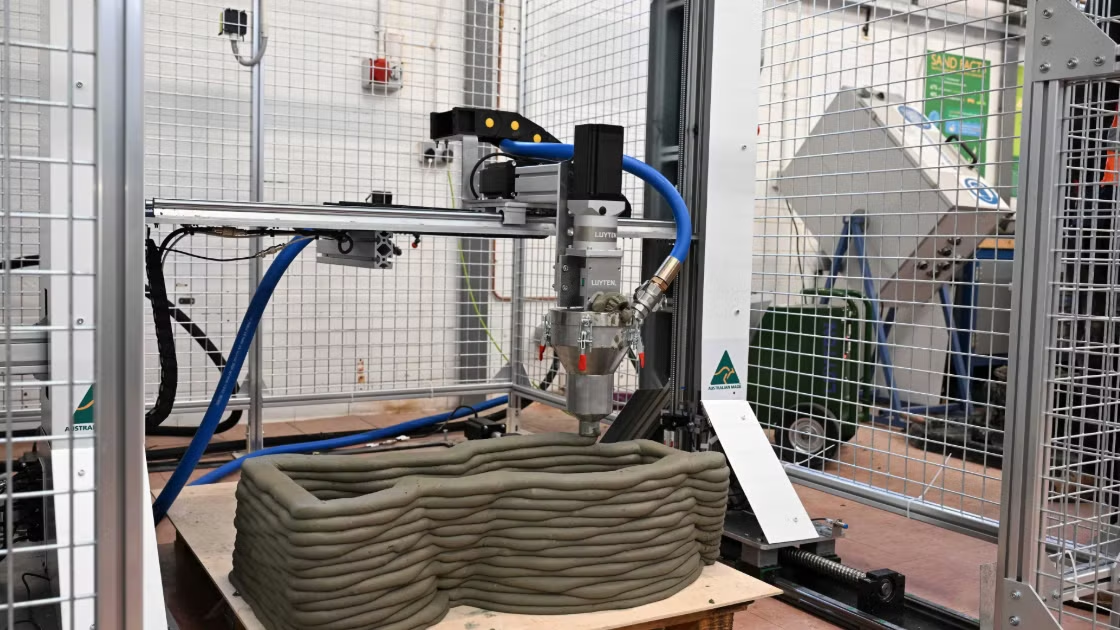
Last year, Northumbria University announced the installation of 3D-printed construction technology in collaboration with Luyten 3D and ChangeMaker 3D, creating a new section of the Northumbria Structures Laboratory.
In Ireland, the first 3D-printed social housing project was launched in Louth County, delivering houses with a 110 square metre floor area.
Results of the Louth project show that housing structures can be built three times faster than with traditional methods of housebuilding.
Funded by Horizon Europe
The MSCA Fellowships, part of the Horizon Europe programme, support postdoctoral researchers in expanding their expertise, undergoing advanced training, and promoting cross-disciplinary and international collaboration.
Dr Jyotirmoy Mishra said: “I am truly honoured to receive the Marie Skłodowska-Curie Postdoctoral Fellowship and to join Northumbria’s world-class Associate Professor Keerthan Poologanathan and his research team. This project allows me to contribute to cutting-edge innovation in sustainable construction by integrating material science, structural engineering, and digital manufacturing.
“The opportunity to explore waste-based alternative activators in 3D-printed geopolymer mortars is both timely and essential for addressing global climate challenges in the built environment. Being awarded the MSCA Postdoctoral Fellowship is a significant milestone that will greatly advance my research career and enable me to translate research into industry-relevant solutions.”
Dr Poologanathan said: “The MSCA Fellowship is a recognition of the Northumbria’s research excellence and reinforces our position as a hub for advanced, interdisciplinary work in sustainable engineering.
“3D-printed concrete is the future of sustainable construction – this research will help to reduce carbon emissions, cut material costs, and minimise waste, while improving the strength and durability of modern infrastructure.”