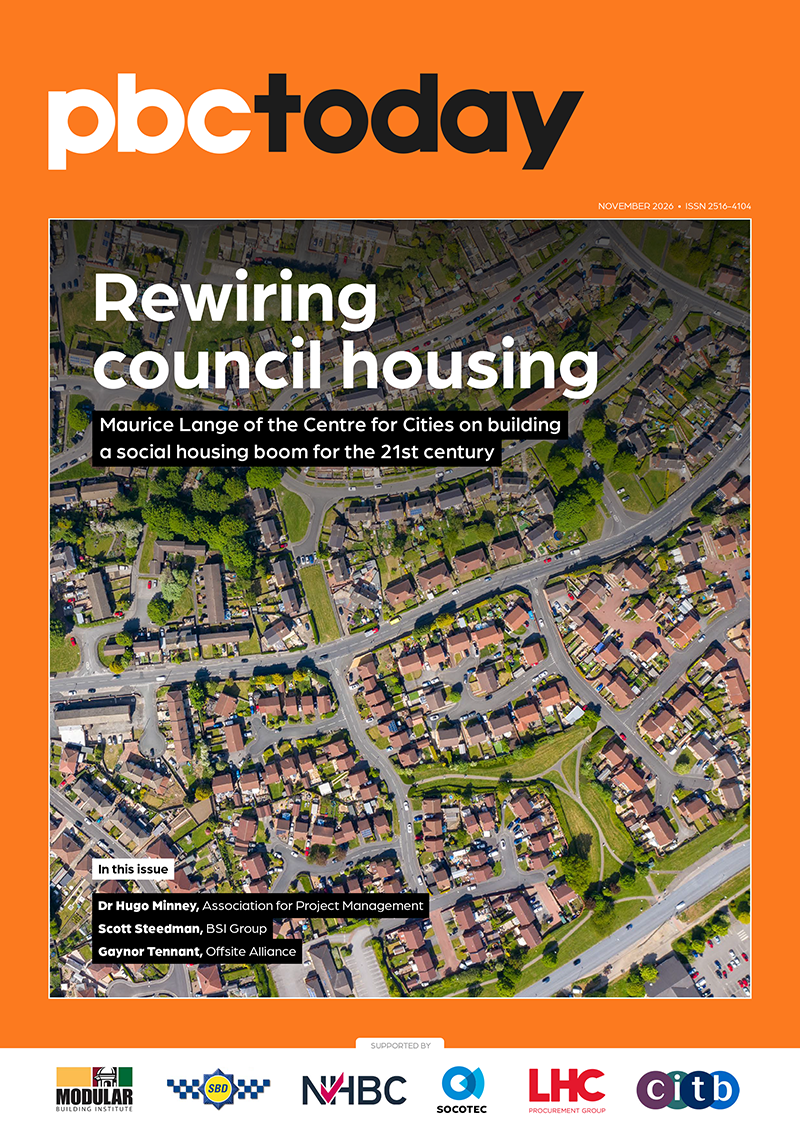

Welcome to the November edition of PBC Today.
As we digest the Budget, the publication looks at everything from council housebuilding and the Future Homes Standard to skills, improving competency in construction and the role of geothermal in the built environment.
In our cover story, Maurice Lange of the Centre for Cities discusses the Rewiring Council Housebuilding report, which sets out its recommendations for a system fit for the 21st century.
Ahead of the Future Homes Standard, Saghir Hussain of architect Create It Studio Architects examines the likely impact for developers, while Simon Storer of the Insulation Manufacturers Association casts a critical eye over Conservative proposals to scrap the standard.
We also hear from Tim Balcon, CEO of the Construction Industry Training Board, who argues that the industry will not solve its skills crisis by looking in the rear view mirror.
Elsewhere, Alastair Robertson, Carly Thorpe and Claire Askew of Walker Morris examine the factors driving insolvencies and the outlook for the construction sector in 2027.
Following this summer’s record-breaking temperatures, Dr Hugo Minney, network lead of the Association for Project Management’s Sustainability Interest Network, cautions that climate change is now a critical feature in how projects are planned.
Gaynor Tennant, founder and chair of the Offsite Alliance, asks if when it comes to improving competency in construction, have we been looking in the wrong places?
As AI demand surges, Lee Gordon of Walker Morris explores the planning reforms affecting data centres, while Paul Bullard of SFG20 looks at where AI can make the biggest impact in facilities management.
Here’s a selection of what’s in store:
1. Rewiring council housebuilding: A programme for the 21st century
If the government wants a council housebuilding boom, it should give mayors a bigger role, writes Maurice Lange, senior analyst at the Centre for Cities.
2. Will green shoots curb construction insolvencies in 2027?
Alastair Robertson, cusses its new Regenerative Places Framework for Housing Carly Thorpe and Claire Askew of law firm Walker Morris examine the factors driving insolvencies and the outlook for the construction sector in 2027
3. Changing the conversation on construction productivity
Construction does not need more data. It needs to make better use of what it already has, argues Dr Danny Murguia of the Cambridge Laing O’Rourke Centre at the University of Cambridge
4. Housing can be a catalyst for thriving places
Tom Butler, policy and places adviser at the UK Green Building Council, discusses its new Regenerative Places Framework for Housing.
5. PAS 9980: A clear and consistent approach to fire safety risks?
Newly revised code of practice aims to improve consistency in external wall fire appraisals.
6. Planning for the heat beneath our feet: Why geothermal belongs in the UK’s built environment
Dr Charlotte Adams, CEO of the National Geothermal Centre, explains why geothermal energy should become standard in new developments, what needs to change to unlock its potential and what the new national strategy asks of government.
7. Construction won’t solve its skills crisis by looking in the rear-view mirror
Construction’s workforce challenges have evolved. The institutions supporting the industry in meeting those challenges must evolve too, writes Tim Balcon, CEO of the Construction Industry Training Board.
8. Competent people need capable organisations
When it comes to improving competency in construction, are we starting in the right place? Gaynor Tennant, founder and chair of the Offsite Alliance and co-founder of ReThink Construction, takes a look.
9. Data centres and planning reform: Which route to take
Lee Gordon, partner in the planning and infrastructure consents team at Walker Morris, examines whether recent planning reforms have genuinely accelerated data centre delivery or simply provided an alternative route through the planning system.
10. AI in facilities management: Understanding where it can make a difference
Recent data reveals that only 24% of FM organisations rate themselves as “AI-ready”. How can the industry move forward with confidence?