


Neil Lawson, managing director & founder, GeoEnergy Design, discusses what’s to come for the Boiler Upgrade Scheme in the latest Budget and the implications of this
Ministers are reportedly preparing to take hundreds of millions of pounds from the Boiler Upgrade Scheme to fund defence. With the Budget on 28 October, the question is whether the industry is left anything to plan around.
On 12 October, the first day of National Heat Pump Week, The Guardian reported that ministers are preparing to take hundreds of millions of pounds out of the £2.7bn Boiler Upgrade Scheme. The Department for Energy Security and Net Zero has been asked to find more than £2bn of savings towards defence. The scheme is not expected to close, and the department says that the savings are a small part of its budget and that it will set out the detail this autumn. The Budget is on 28 October.
Every department is being asked to find money, and no subsidy is meant to last indefinitely. I would put the cost of the pattern alongside the headline, rather than the size of the cut.
A scheme that is working
Ofgem’s figures show a scheme that is still gathering pace. In its first part year, the Boiler Upgrade Scheme paid grants for around 10,000 heating systems. In 2023/24 it was 13,904. In 2024/25 it was 25,331, and in 2025/26 it was 31,104. Applications in 2025/26 were 19% higher than the year before. Since May 2022, the scheme has paid £560.3m towards 80,098 systems, and around three-quarters of those grants replaced fossil-fueled heating.
The growth since 2023/24 followed the increase in the grant to £7,500 in October 2023, up from £5,000 for air source and £6,000 for ground source. Installers and households responded to a grant that was large enough to matter and stable enough to plan around. That is the lesson worth carrying into the Budget.
We have done this before
I have watched this industry build up and stand down more than once. The Green Deal lost its government funding in July 2015. The Green Homes Grant opened in September 2020 and closed to new applicants at the end of March 2021. The domestic Renewable Heat Incentive ran for eight years and was followed by the Boiler Upgrade Scheme without a gap, and that continuity is part of why the market has grown since.
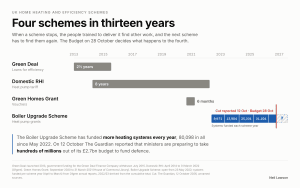
Each time a scheme stops, people who learned the work find other work, and the next scheme must recruit and retrain them. The saving appears in a departmental budget this year. The cost appears two or three years later as a shortage of competent designers and installers, and that shortage is what produces the poorly performing systems that undermine confidence in the technology.
The scheme had 1,789 active installers registered last year. The ten largest accounted for just over a third of applications, and the rest of the work was spread across more than 1,700 other firms, many of which have spent the last three years training engineers and building a pipeline of surveys. A cut that arrives as a smaller pot that runs out partway through the year hits smaller firms hardest, because they are least able to carry the gap.
What the Budget could do instead
If the budget must come down, the industry can plan around it.
Publish a path, not a pot. Set the grant level for the next three years and step it down on a published timetable as installed costs fall. A business can invest against a known reduction. It cannot invest against a scheme that might close in the spring.
Keep the scheme open all year. A pot exhausted in January and refilled in April becomes a queue and a stop. Lowering the grant per installation keeps the work flowing; rationing the number of installations does not.
Protect design and installation quality. Ofgem’s audits last year found an initial compliance rate of 93.1%, but 367 of the 876 compliance investigations that it closed found the installation non-compliant. If the money is tighter, it should go further, and that means systems that are designed properly, commissioned properly and perform as they were meant to.
Keep working on electricity prices. Grants deal with the upfront cost. The running cost is set by the gap between electricity and gas prices, and moving levies off electricity bills would do more for the long-term case than any grant.
The bigger picture
Greg Jackson of Octopus Energy has said that Britain’s exposure to gas cost the Treasury £80bn in the last energy crisis. Whatever view one takes of that figure, heating buildings is one of Britain’s largest uses of gas, and each heat pump installed means one less household is exposed the next time prices spike. That is a security argument as well as a climate one.
France sold four times as many heat pumps as the UK last year. The UK market is growing, the supply chain is growing with it, and the scheme’s supporters say that more than 40% of the money has gone to households earning under £52,000 a year. On 28 October, the Chancellor must choose between a saving visible this year and a cost that will arrive later. I hope that the Budget chooses a path that the industry can plan around.